Spuitbal was an annual recurring event organised by the Aalten Fire Brigade from 1981 to 2016. Each year, this water-filled spectacle attracted many participants and spectators.
Game Setup
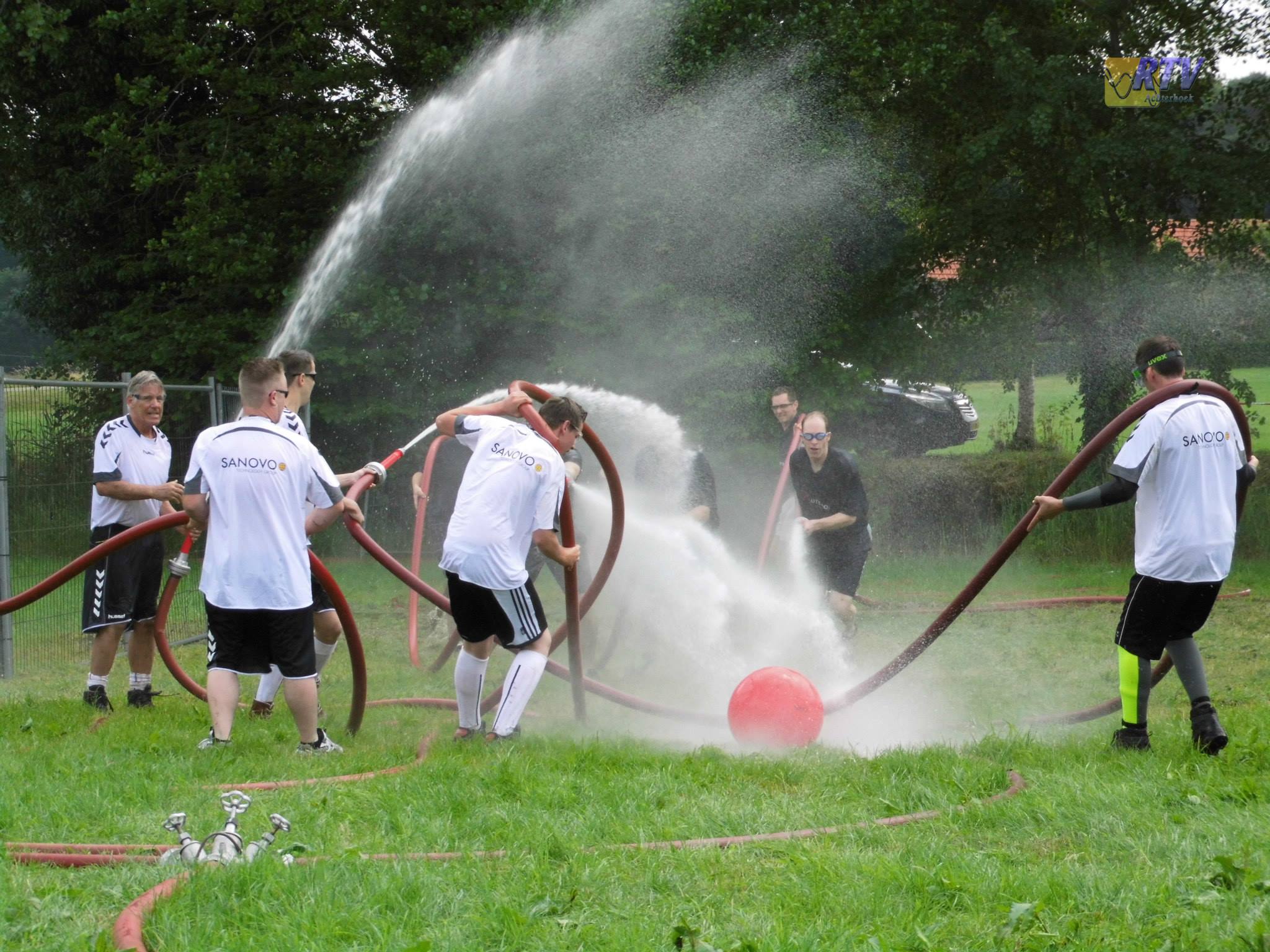
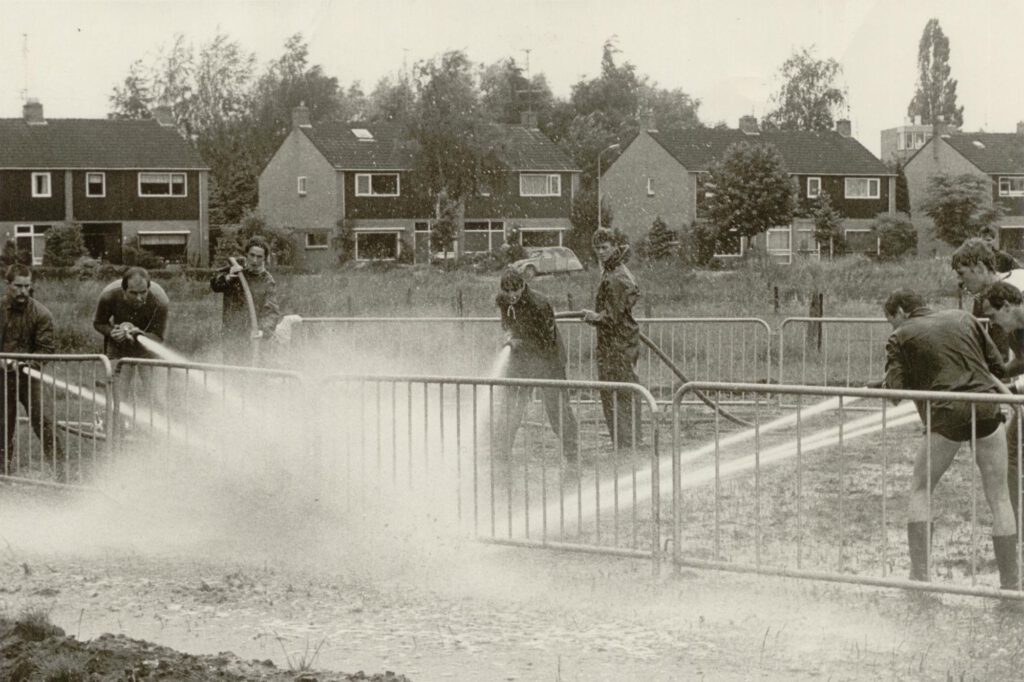
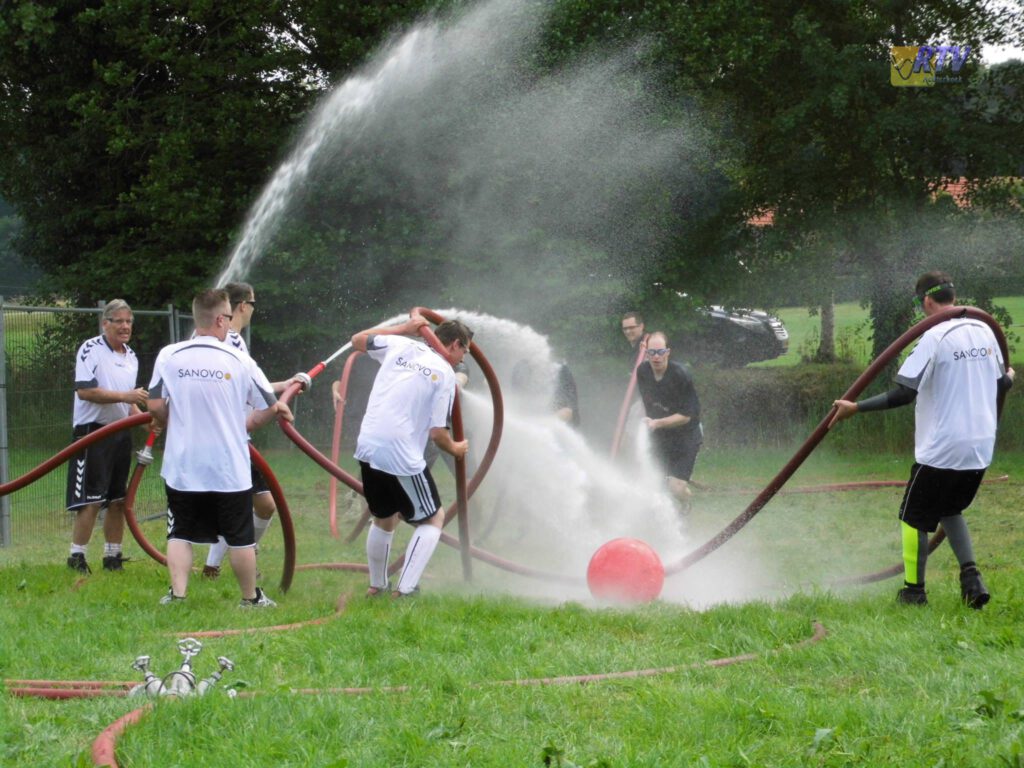
In Spuitbal, two teams of six people competed against each other. Each team operated three fire hoses and tried to push a large ball into the opponents’ goal using powerful jets of water. Each hose was operated by a pair: the front player aimed the jet at the ball, while the rear player had to ensure there were no kinks in the hose. The team that scored the most goals in six minutes won.
Spuitbal tournament at De Ahof (photo: Colenbrander family, via Leo van der Linde)
Spuitbal Aalten, 2015 (photo: RTV Achterhoek)
In the early years, the Spuitbal tournament was organised at various locations, including at De Ahof. In later years, the event took place at Camping Lansbulten on the Eskesweg. The necessary water was pumped from the nearby stream.
In 2008, no fewer than six women’s teams and thirty men’s teams took part. Many teams returned every year, such as De Flippers, De Pimpels, De Pollekes, Atlantic, Schiller, ’t Noorden, and Jong Gelre.
The 36th (and, as of yet, final) edition took place in 2016. In 2017, the event was cancelled due to insufficient interest, and it has not returned since.
Video
On YouTube, various videos can be found of Spuitbal in Aalten, such as the video below from Jong Gelre from 2012.
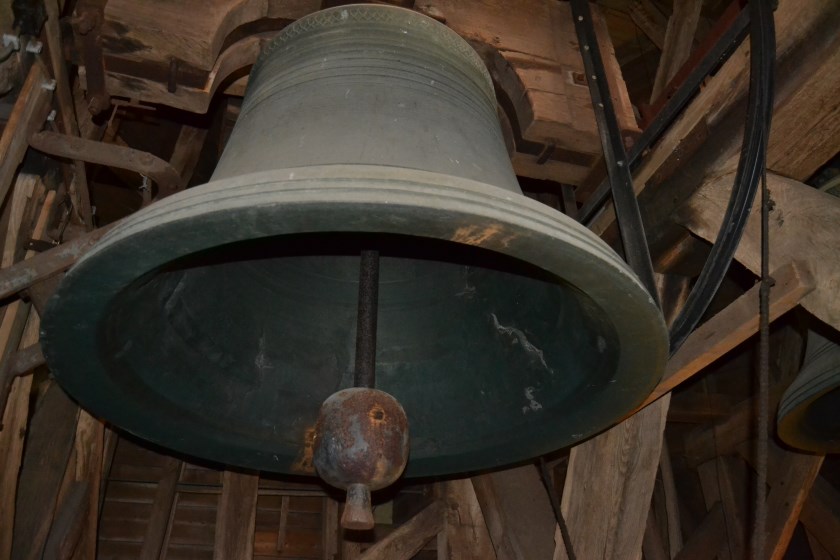
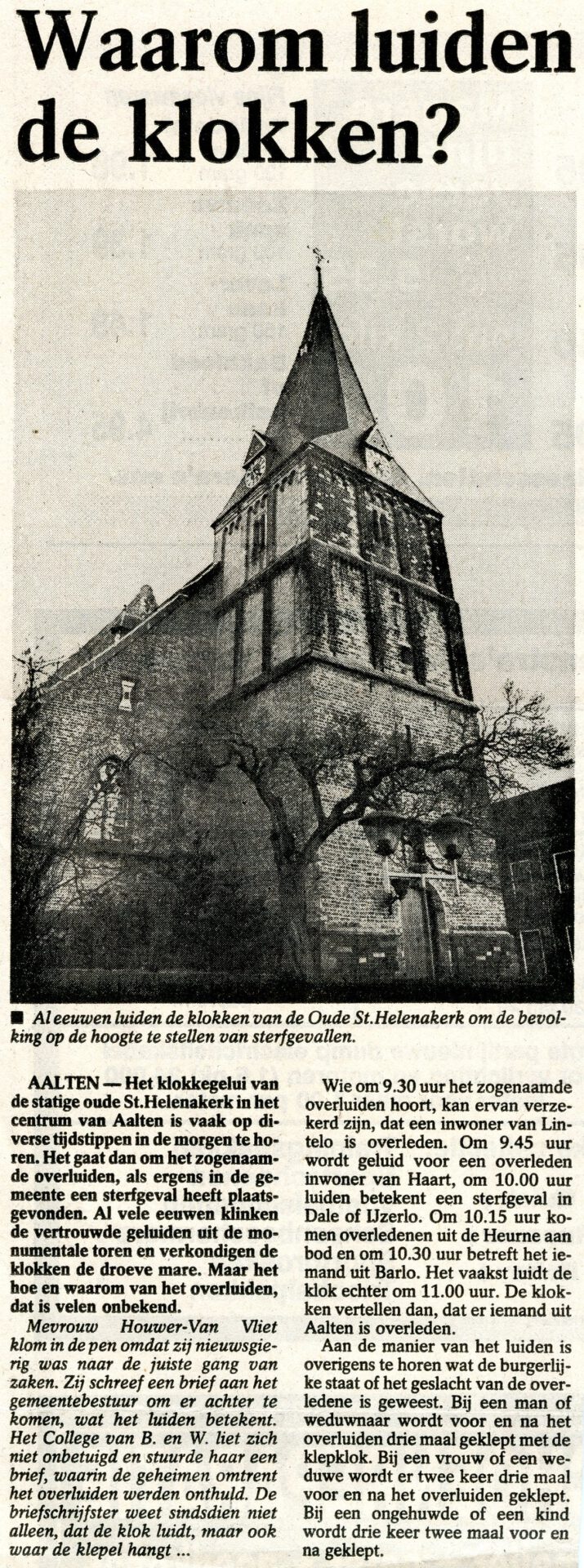
For centuries, the bells of the Oude Sint Helenakerk in Aalten have tolled to inform the population of deaths, the so-called ‘overluiden’.
It frequently happens that the bells of Old St Helen’s Church are tolled at various times in the morning. In the past, this occurred more often than it does today. In former times, almost everyone knew what this signified. Based on the time and the number of strokes, people could deduce in which rural district someone had died, as well as whether it was a child, a woman, or a man, and whether the deceased was married or unmarried.
The custom of tolling the bells when a death has occurred is called ‘overluiden’. For many centuries, the sound of bells has emanated from the monumental tower of the church on weekdays. Many people pause for a moment and think: memento mori.
The bells of Old St Helen’s Church on the Market Square in Aalten are still used for this solemn moment, always in consultation with the next of kin. The ‘overluiden’ can be performed for all deceased persons, not just for members of the Protestant Congregation.
Significance
If the bells are tolled at 9:30 AM, it concerns a resident of the rural district of Lintelo. If it occurs at 9:45 AM, someone from de Haart has passed away. At 10:00 AM, the bells toll for a death in Dale or IJzerlo, and at 10:15 AM for someone from the Aaltense Heurne. If it concerns someone from Barlo, the time is 10:30 AM. Often the bells toll at 11:00 AM, which signifies the ‘overluiden’ of a deceased person from the village of Aalten.
For a man or widower, the clapper bell is struck three times before and after the tolling. For a woman or widow, the clapper bell is struck twice three times before and after the tolling. For an unmarried person or a child, this occurs three times twice before and after the tolling.
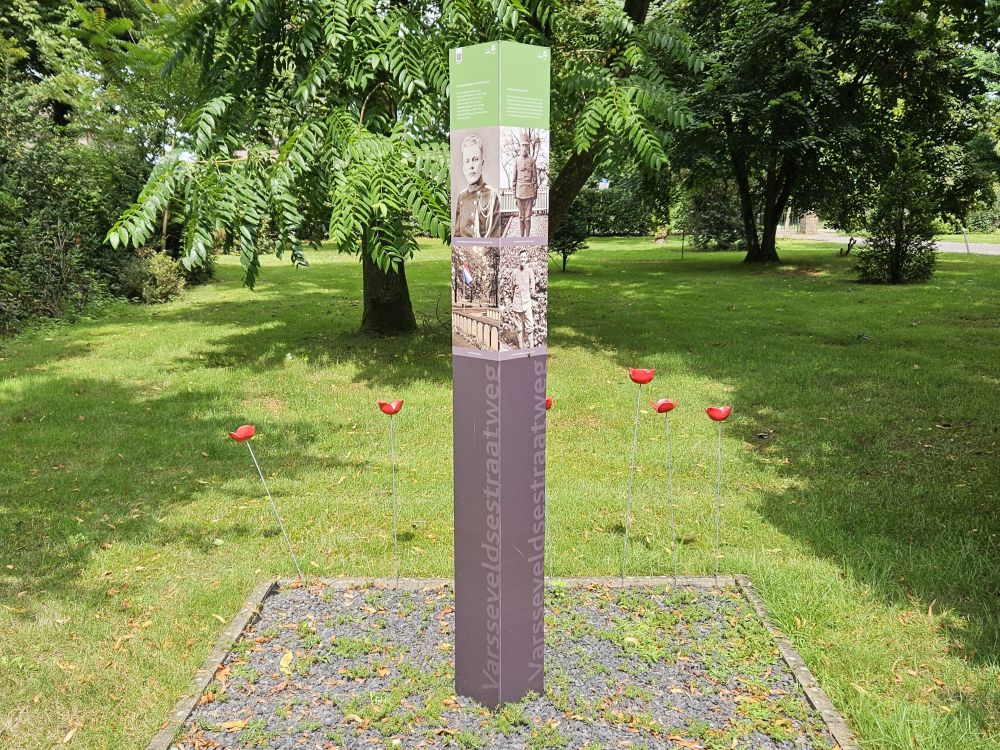
In 2015, as part of the commemorations for 70 years of liberation, a commemorative column was placed at the Old General Cemetery in Aalten to honour all local soldiers who fought on and around the Grebbeberg in May 1940. Seven servicemen from Aalten lost their lives during the conflict. Their names and photographs have been immortalised on the column.
The text on the column reads:
Soldiers from Aalten in May 1940
In the early morning of 10 May 1940, German troops invaded the neutral Netherlands. For our country, this marked the beginning of World War II. Mobilised Dutch soldiers took up positions in several lines of defence, including the Grebbe Line. Fierce fighting took place in the main resistance strip on and around the Grebbeberg near Rhenen.
Photo: R. Neerhof, 2025
Most soldiers survived the battle and were able to return to Aalten, often after a brief period as prisoners of war. Seven families remained in a state of uncertainty for some time. Eventually, they received the tragic news that their sons would not be returning; they had fallen in battle. Their lives were devastated by this great loss. At this site, all Aalten soldiers who fought in May 1940 are remembered.
Many residents of the Achterhoek, including a considerable number of young men from Aalten, were assigned to the 8th Infantry Regiment (8 R.I.). This unit played a vital role in the defence of the Grebbeberg. The poorly trained and equipped soldiers fought an unequal battle against an overwhelming enemy. Bravely, they attempted to hold their ground for as long as possible. The Germans, with awe, referred to the hill as ‘Der Teufelsberg’ (The Devil’s Mountain). Nevertheless, our country was forced to capitulate on 14 May 1940.
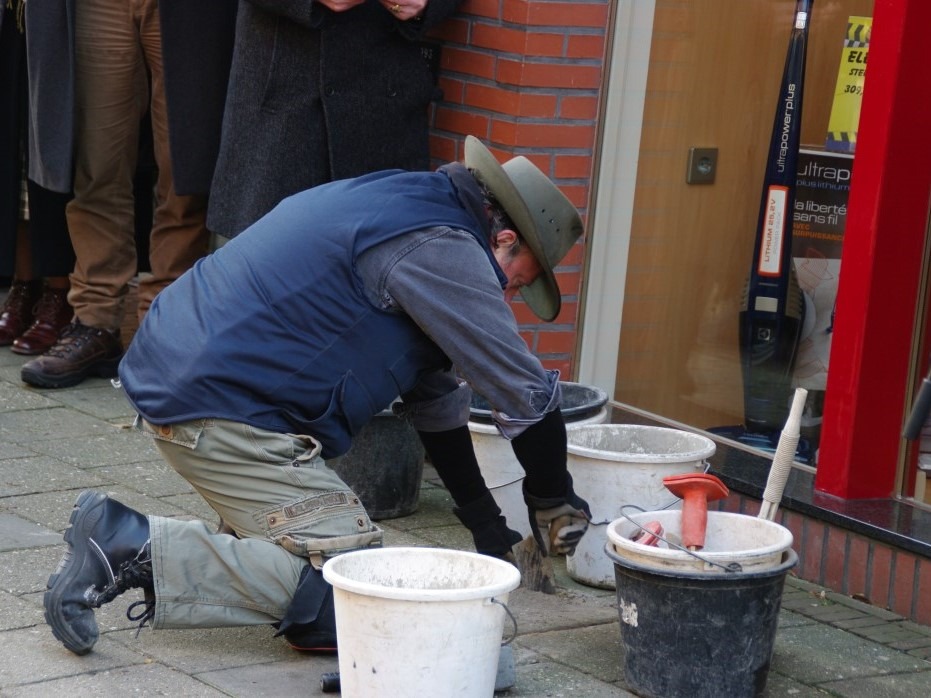
Gunter Demnig placing the first Stolpersteine in Aalten
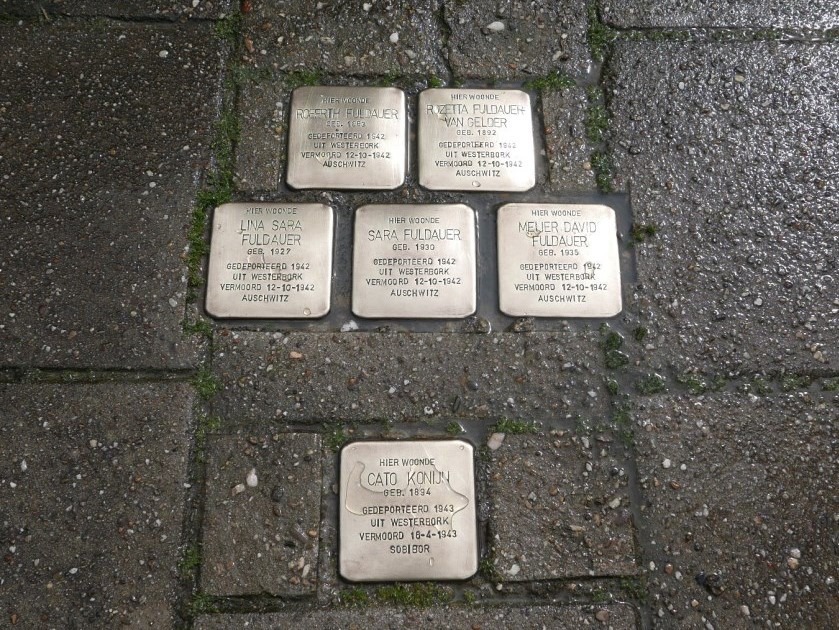
In Aalten, 34 Stolpersteine (stumbling stones) are laid across twelve addresses. A Stolperstein is a memorial stone placed in the pavement in front of the house from which people were deported by the Nazis to extermination camps during World War II. When you see such a stone—usually unexpectedly—with the name of a victim, you are momentarily reminded of how millions became victims of systematic murder during that war.
The stones have a surface area of 10 by 10 cm. A brass plate is affixed to the top, into which the name, year of birth, date of deportation, and the place and date of death are stamped. Each stone serves as a memorial to a single victim: a person who lived in that very spot and was deported from there, never to return.
Originator
The Stolpersteine project was conceived by the German artist Gunter Demnig. He deliberately kept the size of these ‘stones of offence’ small, requiring one to bow down to read the inscriptions.
Demnig began laying the first Stolperstein in 1997 in the Berlin district of Kreuzberg. Today, Stolpersteine can be found in many countries. Gunter Demnig thus gives every victim their own individual monument. His motto is: “A person is only forgotten when his or her name is forgotten.”
Initially, he made all the stones himself, as he felt mass production conflicted with the project’s ethos. However, forced by the project’s rapid growth, he is now assisted by an artist friend. He insists on personally laying the first stones in any given location. The remaining stones are now usually installed by municipal pavers.
Stolpersteine in Aalten
In Aalten, 34 Stolpersteine have been laid at the following addresses:
’t Dal 1: Levi Salomon Schaap, Ella Schaap-Philips, Eliazar Hars Schaap, Frits Landau, Amalia Landau-Lorch
Dijkstraat 10a: Levie van Gelder, Jula van Gelder-Landau, Arnold van Gelder
Eerste Broekdijk 51: Roberth Fuldauer, Rozetta Fuldauer-van Gelder, Lina Sara Fuldauer, Sara Fuldauer, Meijer David Fuldauer, Cato Konijn
Grevinkweg 5: Sally Fuldauer, Regina Fuldauer-de Jong
In one instance, the stone could not be placed in front of the victim’s residence because the building (Industriestraat 4) no longer exists, nor is there a pavement where it could be installed. Therefore, this stone was laid in front of the synagogue.
In 2011, Aalten made national headlines due to a remarkable story: a small religious community had settled at the Rensink farm in Lintelo, awaiting the Apocalypse. They called themselves the ‘Wachters van de Nacht’ (Watchers of the Night).
At their farm, they were preparing for survival during the end times. According to them, the Apocalypse would soon arrive with a tsunami, causing large parts of the Netherlands to be submerged underwater. Higher-lying Aalten would, as a result, find itself located on the coast.
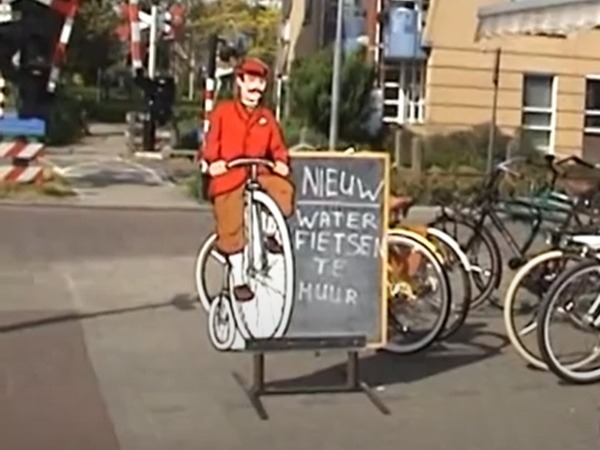
Jokers posted satirical videos on YouTube in which Aalten-on-Sea was presented as a sunny seaside resort, where the local retail sector had effortlessly adapted to the demand for beach entertainment. However, according to the Watchers themselves, anyone who ignored their warnings would have to face the consequences. A drowning death awaited them. In the meantime, the Watchers stocked up on large food supplies for the refugees they expected to arrive from the Randstad (the major urban area in the west of the Netherlands).
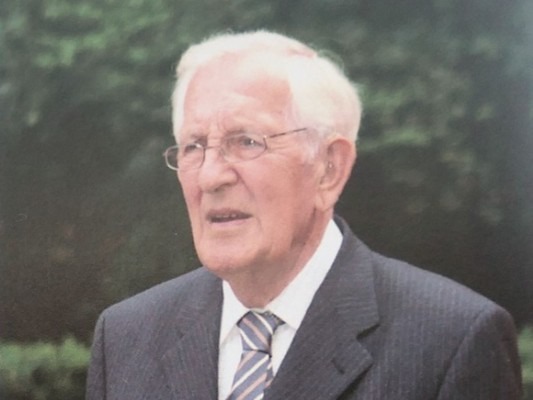
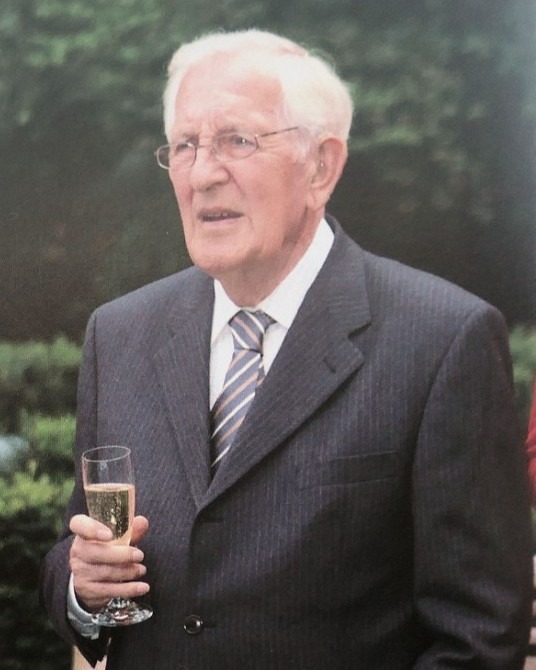
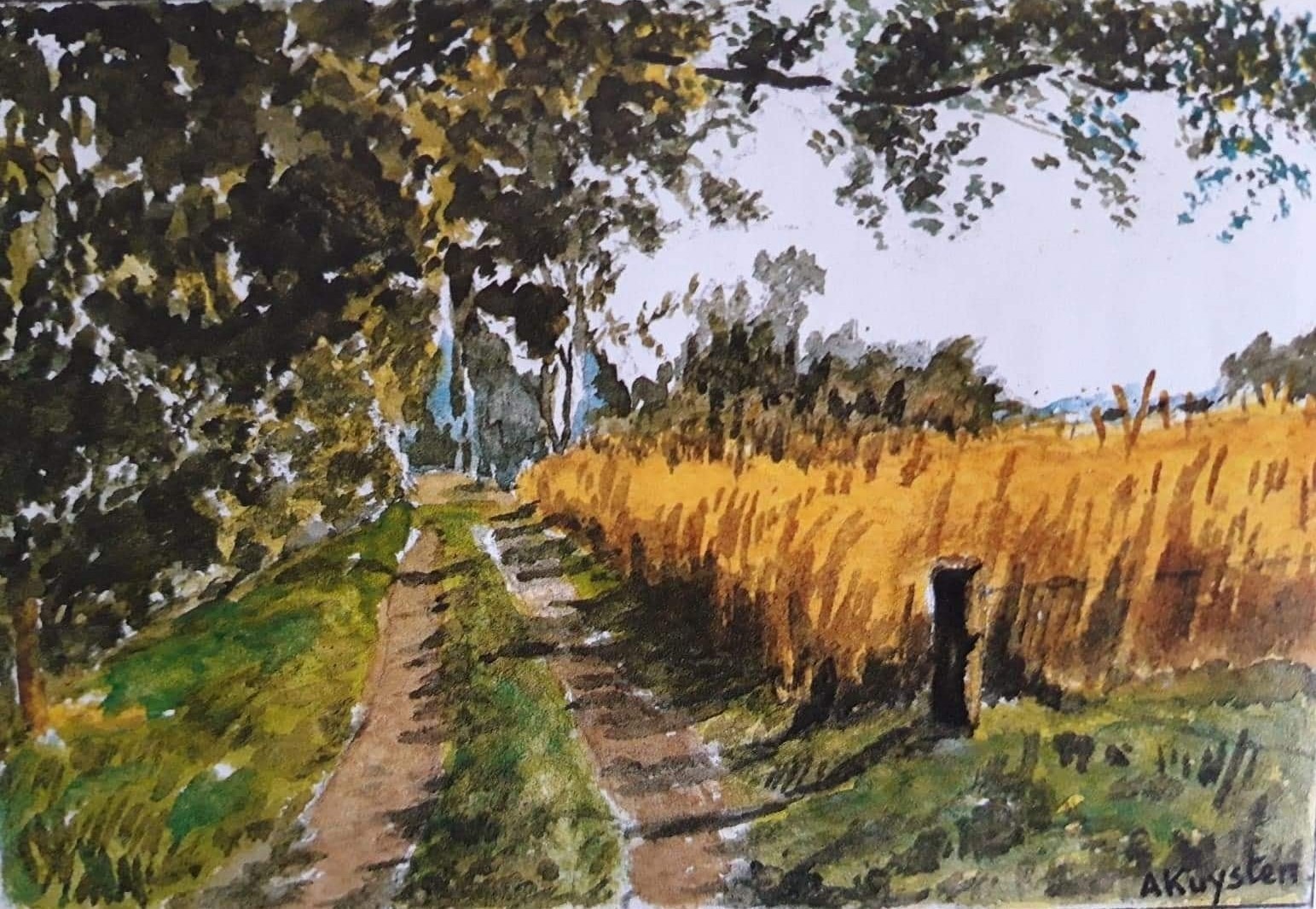
Antonie (Anton) Kuijsten (1917–2007) was a teacher and headteacher in Aalten, as well as a self-taught woodcarver, draughtsman and watercolourist. From its founding until his retirement, he led the Reformed (Hervormde) School Aalten-Zuid (later renamed De Broekhof). His surname is also frequently spelt as Kuysten.
Kuijsten was born on 5 October 1917 in Huizen. His mother passed away when he was eight years old, but thanks to the way his father supported the family and the live-in housekeeper who remained with them for a long time, he still enjoyed a happy childhood.
After graduating from the teacher training college (kweekschool) in Amsterdam, Kuijsten taught at various locations, including Naarden, Muiden, Rheden—where he met his future wife—and Zutphen. During the final months of the occupation, he went into hiding to avoid being forced to work for the occupying forces. On 11 April 1947, he married Hendrina Groenewoud in Rheden.
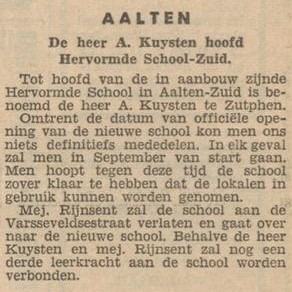
Upon the opening of the 2nd Dutch Reformed School Aalten-Zuid in 1954 (which later became the Broekhofschool), he was appointed as headteacher. Kuijsten was renowned as a storyteller who brought history lessons to life “as if he had been there himself”. By 1967, the family was living at Wilhelminastraat 4 in Aalten. He was also highly active within the Protestant Church: for over twenty years, he led the children’s church services in Aalten-Zuid, and he served as an elder for a period of time.
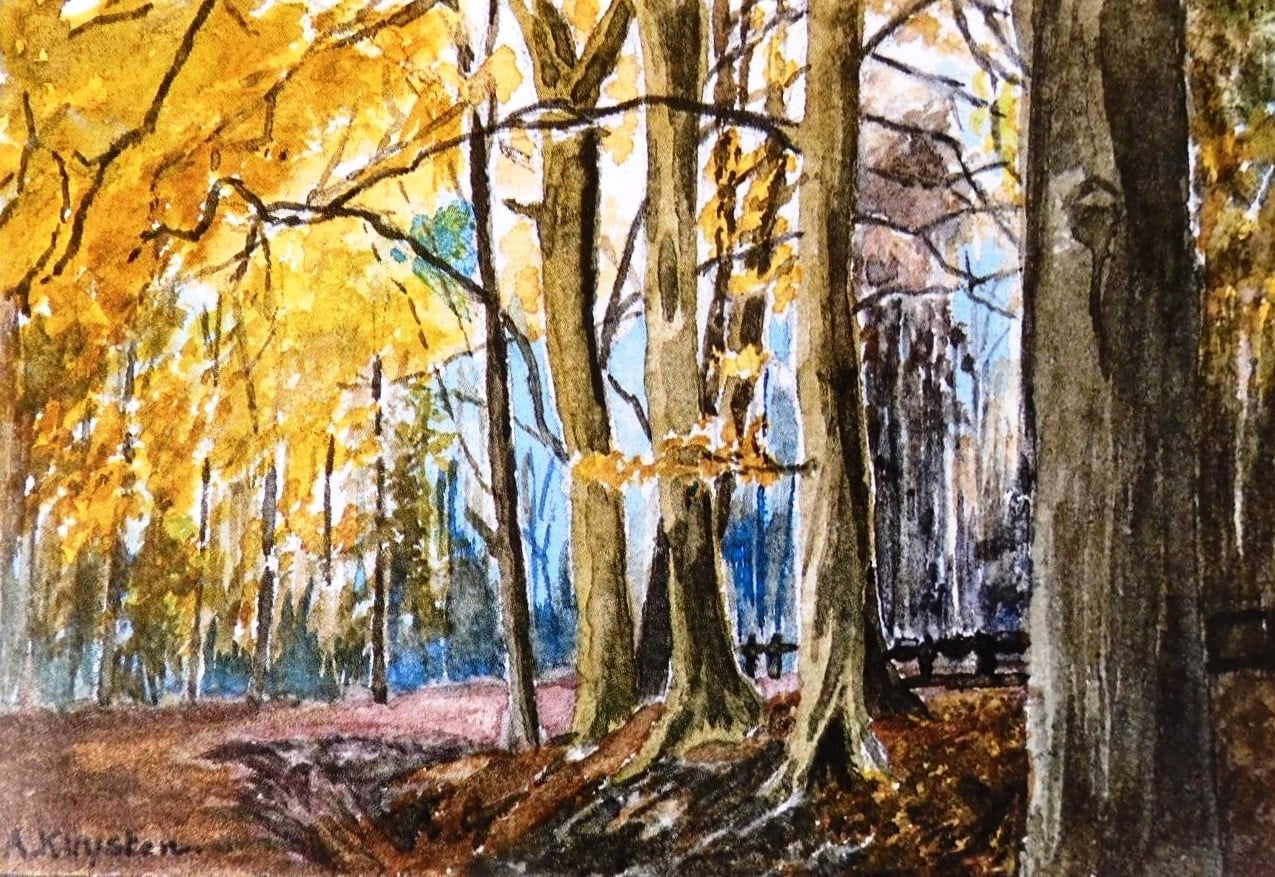
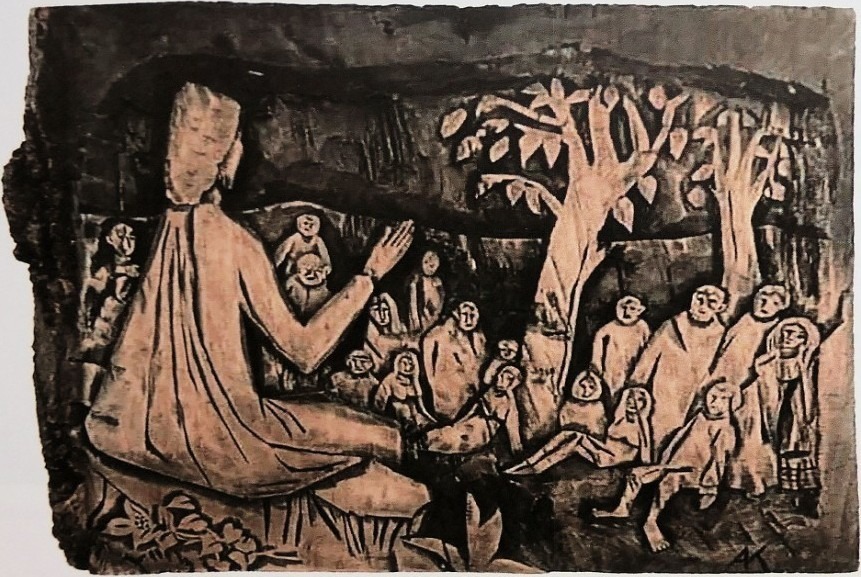
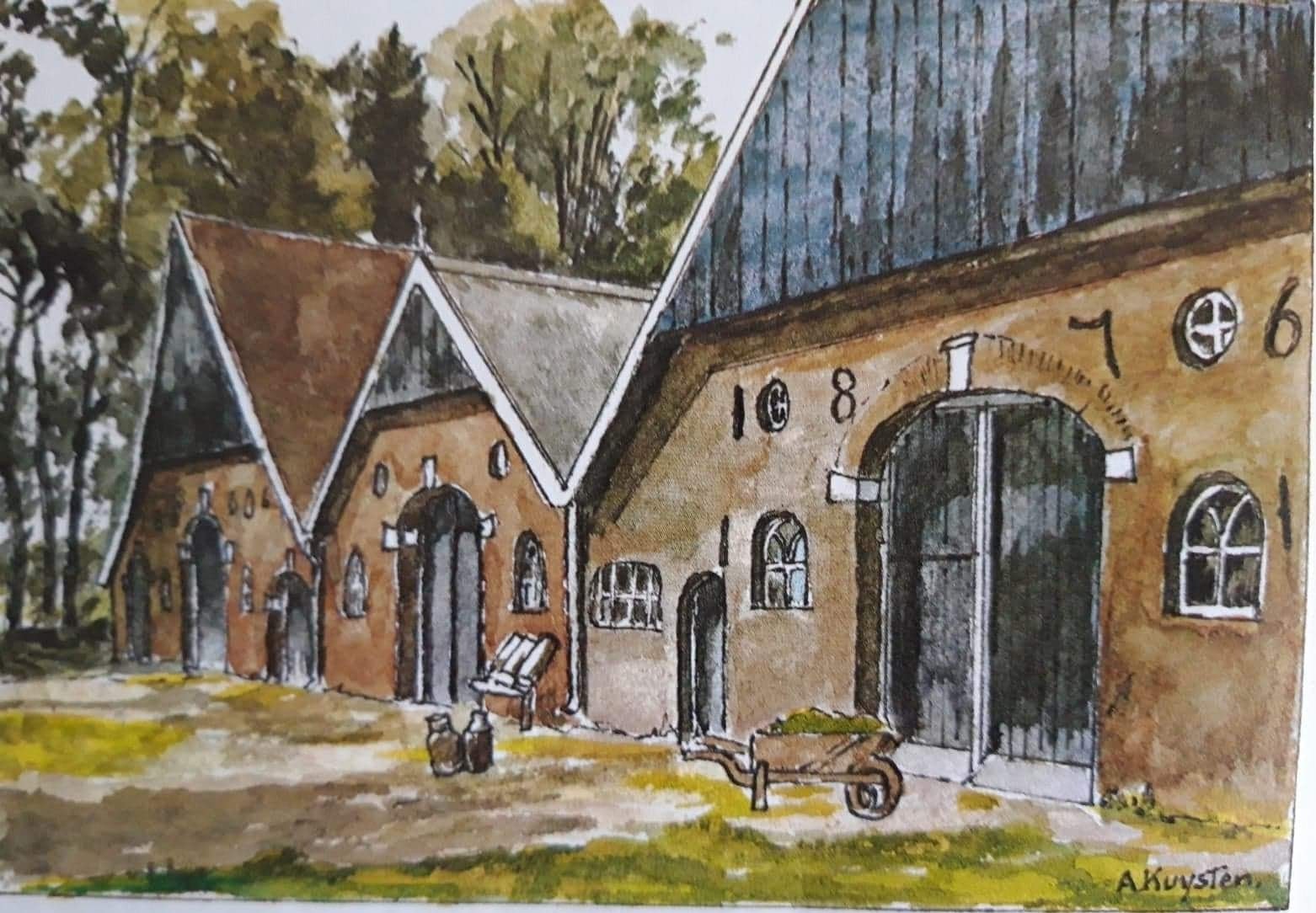
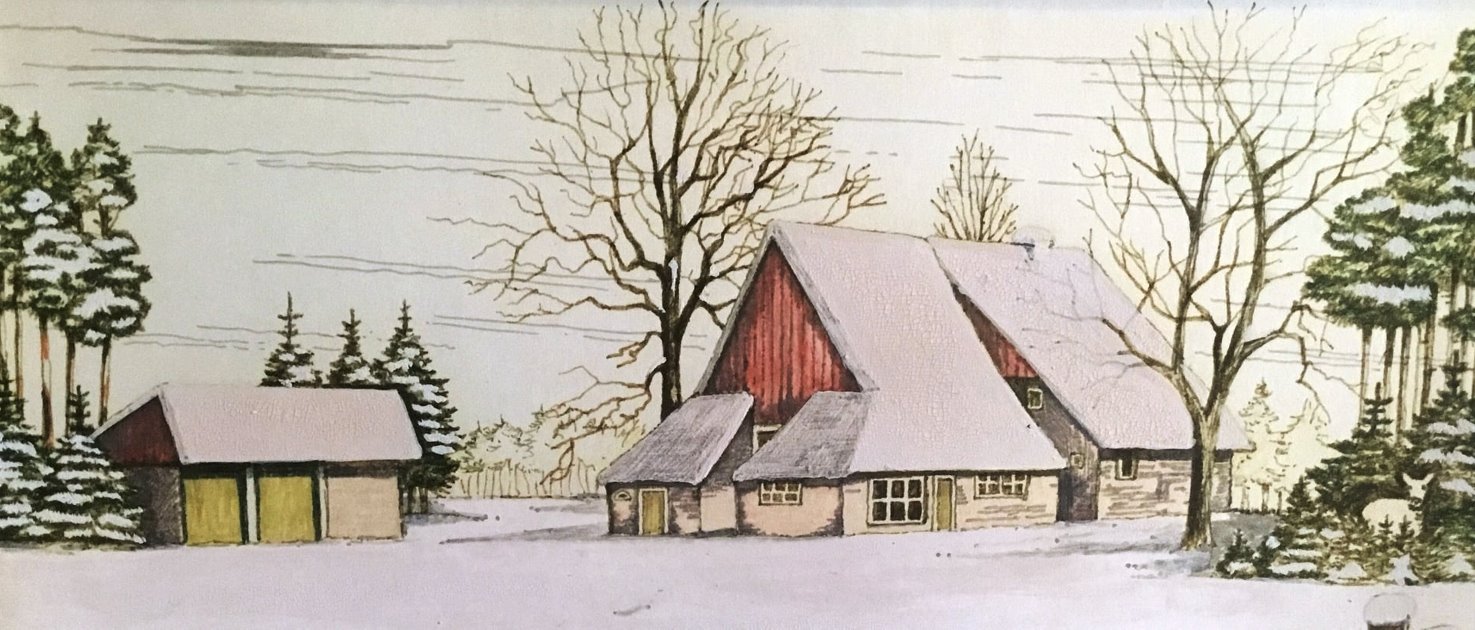
Alongside his teaching career, Kuijsten developed his skills as a self-taught woodcarver, draughtsman and painter. In addition to watercolours, he produced drawings using liquid watercolour (ecoline). He also created items such as birthday calendars. He is featured in the book Kunstig Aalten (2021), an overview of artists from Aalten compiled by Leo van der Linde.
The sudden death of his wife in 1987 was a profound loss. For several years, he laid down his brush and pencil, though he fortunately managed to resume his creative work later on. In the final phase of his life, he faced frail health. Following an admission to the hospital in Winterswijk and a short stay at the ’t Hoge Veld care home, he ultimately passed away in hospital. The funeral took place on 1 December 2007, following a thanksgiving service at the Old Helenakerk in Aalten. He was laid to rest at the Berkenhove cemetery.
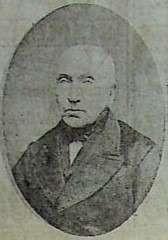
Anton Kuysten (1917–2007)Zutphens Dagblad, 10 May 1954
Gallery
A selection of works by Anton Kuijsten:
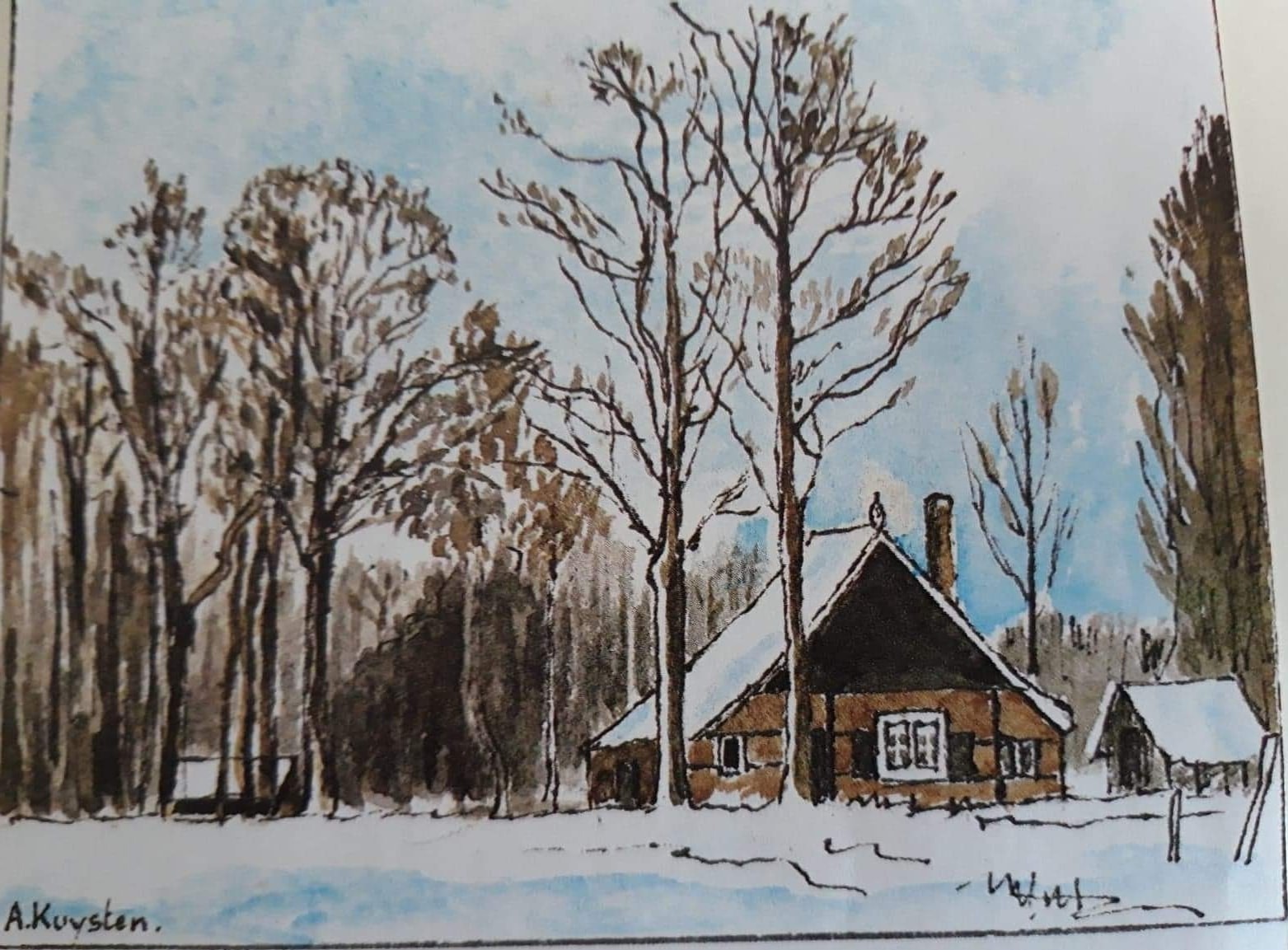
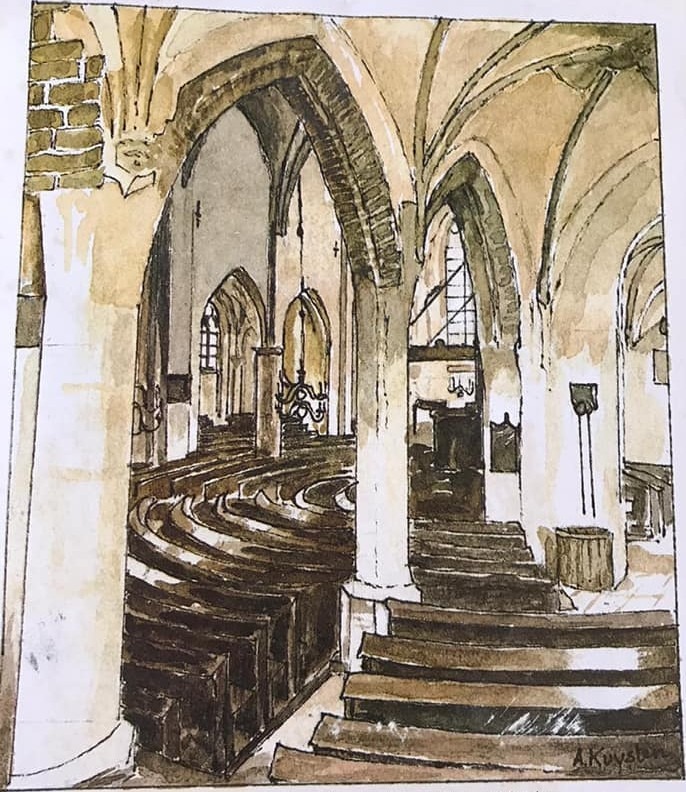
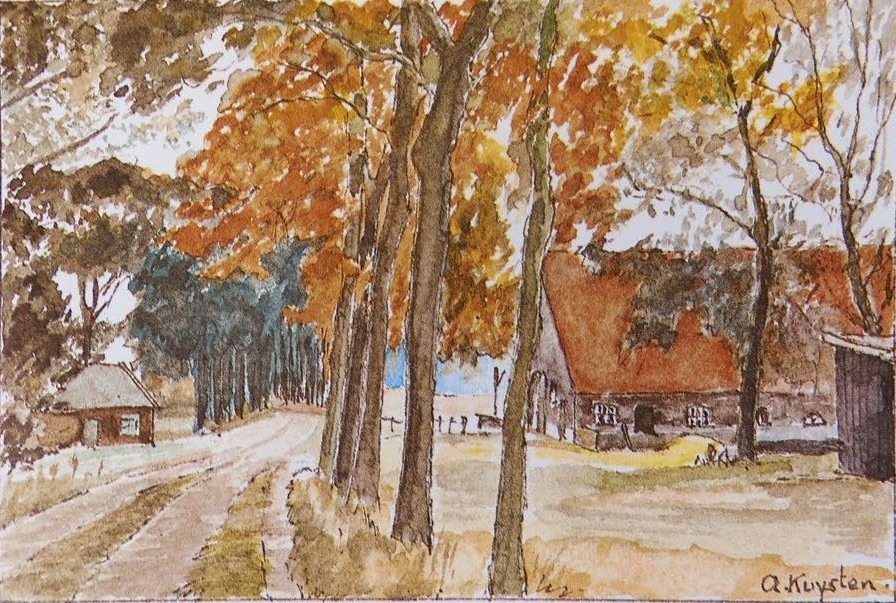
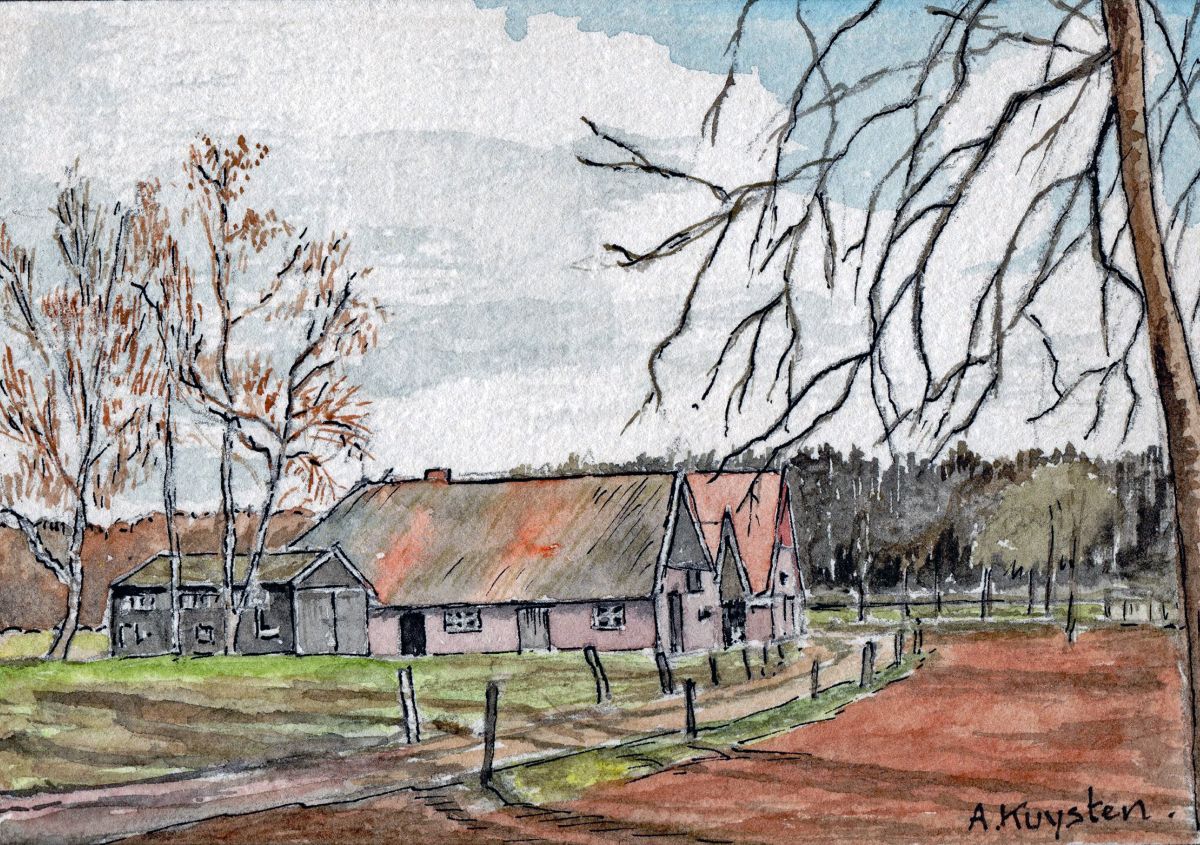
The Kloosterbos (Monastery Woods) near BredevoortThe Sermon on the Mount, woodcarving‘Beestman’ farmhouse on the Haart near Aalten (rear view)Eskes farmhouse in winter on the Haart in AaltenInterior of the Big or St Helen’s Church in Aalten, south sideHijinkdijk, HaartAkkermateweg, LinteloCountry lane on the Akkermateweg in Aalten
Huisstededijk, IJzerlo (just before the Keizersbeek bridge)
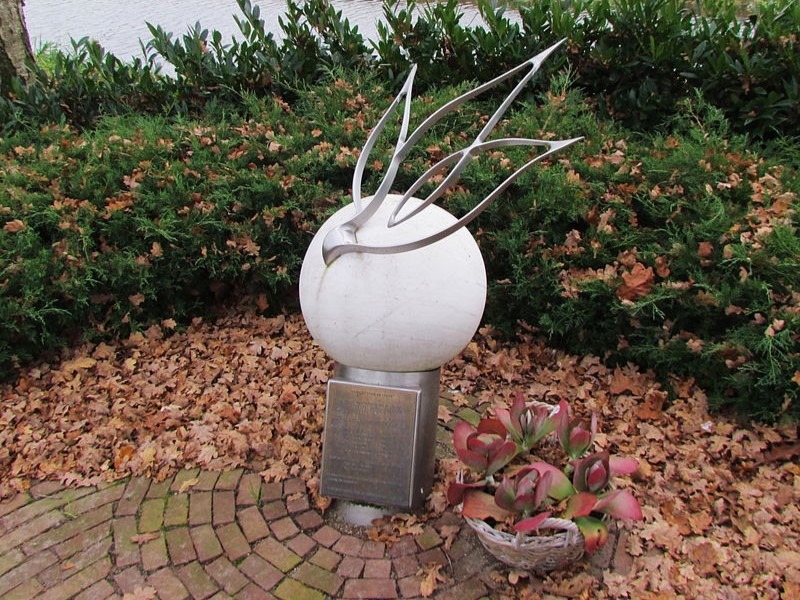
The ‘Flying for Peace’ (Vliegen voor de Vrede) monument is a commemorative memorial located on Huisstededijk in the Aalten rural district of IJzerlo. The monument was erected in memory of the crash of a British bomber during World War II, which came down in a nearby potato field on the night of 26 June 1943.
On that particular night, over 400 British bombers flew over the Achterhoek on a mission to bomb the petrochemical industry in Gelsenkirchen. One of these aircraft, a Short Stirling BK767 of 214 Squadron, Royal Air Force, with seven crew members on board, had taken off just before midnight on 25 June.
At approximately 01:20, the aircraft was set ablaze by night fighter pilot Oberleutnant Ludwig Meister, flying a Messerschmitt Bf 110 G-4 that had recently scrambled from Venlo airfield. The Stirling crashed into a potato field between the farms of the Van Lochem family on Huisstededijk and the Ter Horst family on Veldweg.
Of the seven crew members, only two survived the crash. They were later captured near Hemden and spent the remainder of the war in German prisoner-of-war camps. The other five crew members perished and were buried following a brief ceremony on 29 June 1943 at Berkenhove Cemetery in Aalten.
The following day, many Aalten residents flocked to the cemetery. On the middle grave, members of the underground resistance laid a wreath with ribbons bearing the text: “Gebroken vleugels, onsterfelijke roem” (Broken wings, immortal fame). By order of the occupying forces, these words had to be removed, but they live on through the monument today.
Survivors (taken prisoner): • F/O K.A. Nielson • Sgt E.G. Taylor
The Monument
In 2003, a monument was unveiled at the spot where one of the crew members’ bodies was found, near the cycle bridge over the stream on Huisstededijk. The creator, Wim Westerveld, gave it the name ‘Flying for Peace’ and designed an artwork containing multiple layers of symbolism.
The monument consists of a white stone sphere topped with a metal sculpture that, from certain angles, represents a dove and, from others, flames. The sphere rests on a metal pipe angled into the ground, to which a plaque is attached. One of the two survivors, navigator Edwin Taylor (born 1922), was present at the unveiling of the monument.
Significance
The sculpture represents the Earth with a dove of peace on top, symbolising the desire for peace. However, from certain viewpoints, the dove transforms into flames, symbolising the tragic event of the crash and the fiery dedication of the crew to their mission. The flames also refer to the fire of the bomb load the aircraft was carrying. The broken wings on the monument are a symbol of the crew’s abruptly ended mission.
The monument serves not only as a memorial to the crew of Stirling BK767 but also conveys a broader message. It acts as a warning against war and reminds us of the freedom we enjoy today. It calls upon us to cherish this freedom and to grant it to others as well.
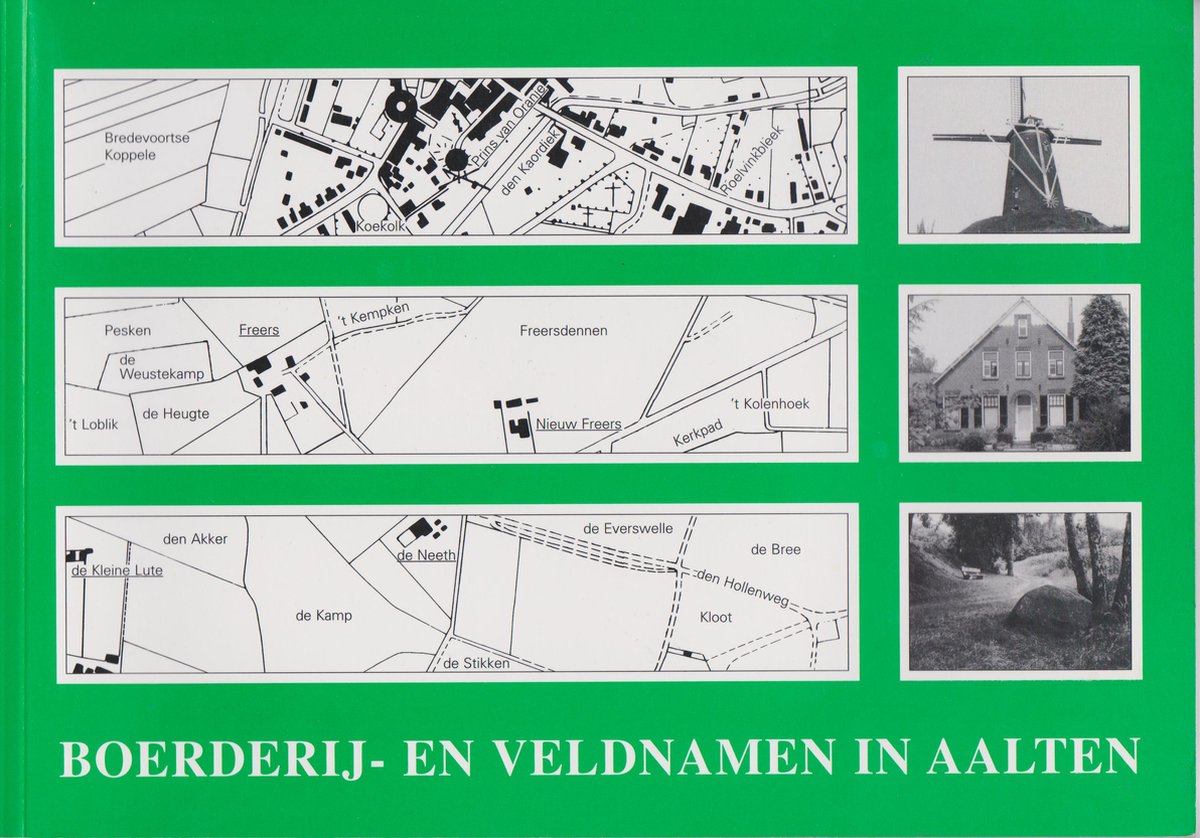
A highly valuable source of information for Old Aalten is the publication Boerderij- en Veldnamen in Aalten (Farm and Field Names in Aalten). It is an important reference work of toponyms in the municipality of Aalten, prior to the municipal reorganization with Dinxperlo in 2005.1 It provides insight into the names of farms and parcels as they were often used for centuries, before land consolidation and modernization left their mark on the landscape.
Objective and Content
The primary goal of this edition was to record historical farm and field names for posterity. This reference work contains a register with approximately 750 farm names and more than 1,650 field names. Additionally, it features numerous photographs, explanations of the naming conventions, and topographical maps.
The information was collected by the Oudheidkundige Werkgemeenschap Aalten-Dinxperlo-Wisch (ADW), under the coordination of B.J. Dorrestijn. The final compilation was established under the editorship of Loes Maas and Mr. A.H.G. Schaars of the Staring Instituut in Doetinchem, which later merged into the Erfgoedcentrum Achterhoek & Liemers (ECAL).
Historical Significance
The farm and field names reveal much about the history of the agricultural landscape in Aalten. They often refer to the location or use of the parcel, the families who lived there, or the professions practiced. For farmers, it was practical to use a single name to indicate where the laborer, farmhand, or smallholder (katerboer) needed to plow, harrow, or sow.
Many of these names were mentioned in archives and documents centuries ago, for example, to record ownership and occupancy. However, since the land consolidation, field names have fallen into disuse, and the introduction of street names in 1967 also reduced the use of farm names. For genealogists and local historians, however, they remain important starting points for genealogical research and the study of regional history. 2
Availability
Although the publication is no longer available as new, second-hand copies can still be found through antiquarian bookstores and private sellers.
Extent: 112 pages
Format: 297×210 mm (A4), landscape
Compilers: B.J. Dorrestijn (coordination); Loes H. Maas, A.H.G. Schaars (editing)
Publisher: Staring Instituut / Mr. H.J. Steenbergen-Stichting / Oudheidkundige Werkgemeenschap ADW, 2002
ISBN: 90-73667-53-4
Footnotes
In 2024, Boerderij- en Veldnamen in Dinxperlo (Farm and Field Names in Dinxperlo) was published (source) ↩︎
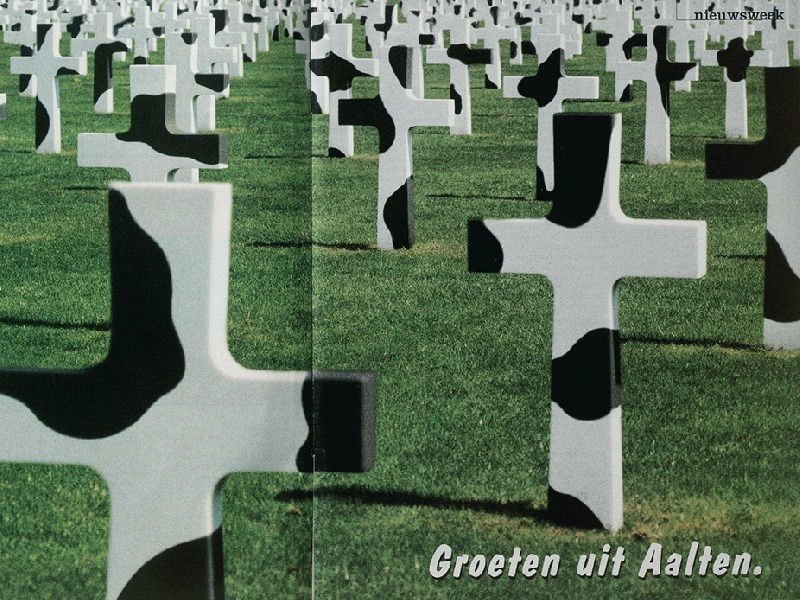
On 11 April 1996, Aalten was briefly global news. At the Kropveld-Schipstal Aalten (KSA) abattoir, 64,000 British calves were to be culled. This was carried out by order of the Ministry of Agriculture due to the potential contamination with ‘mad cow disease’, or BSE.
Never before in Dutch history had calves been transported to the abattoir with such spectacle as the first 108 head of cattle brought to Aalten from the Veluwe that day. The operation, which was to last six weeks, caused a great stir in the Netherlands and beyond.
For KSA, the slaughter of the 64,000 calves was a massive, and certainly financially attractive, job. The company normally slaughtered 2,000 calves weekly for the Japanese market. Those operations were suspended for six weeks for this special commission, during which approximately 10,000 calves had to be slaughtered per week.
Image: KesselsKramer, Amsterdam
Demonstrations
The lorries in which the animals made their way to the slaughterhouse were escorted by two riot police control vehicles. Upon arrival at KSA, they were met by a crowd of activists and curious onlookers. Members of animal welfare organisations, such as the Vegetarian Association, Lekker Dier, and PETA, had taken up positions at the abattoir fence with banners and sandwich boards. A funeral wreath hung on the metal gate, wooden crosses lay on the street, and the protesters wore black clothing.
As the first three lorry combinations carrying calves approached the iron gate of KSA, the jeering of the crowd swelled. “Murderers, murderers”, chanted a motley mixture of animal rights activists and local teenagers towards the drivers. Half a minute later, the gate slammed shut again. The slaughter could begin.
The private security service hired by the KSA management after a bomb threat had been received at the company the day before ensured that none of the protesters could enter the abattoir grounds. When the gate was closed again, a young PETA sympathiser collapsed and gave free rein to her tears. A group of locals reacted indifferently to the silent grief. Pointing at the piercing the girl had had placed through her lower lip, a corpulent Aalten resident lisped: “A piece of rope through that ring and she wouldn’t look out of place among those calves…”
Press conference
On the day of the arrival of the first British calves, a press centre was set up in café De Driesprong. Mayor Tijme Bouwers presided over the press conference. The municipality of Aalten provided logistical measures to clear the way for the dozens of lorries delivering thousands of calves daily. KSA director H. Swinkels emphasised that stringent safety measures had been taken regarding the potential risks of contamination.
To see for themselves that the slaughter was painless for the animals and, due to the measures taken, risk-free for the staff, journalists were allowed a look inside the abattoir later that afternoon. Wearing special overalls that were destroyed after use, the tour led past the slaughter hall and the specially refrigerated storage silos for the blood. This viscous mass—a total of 450,000 litres—was transported by tanker to Rotterdam to be incinerated. The carcasses were sent daily in sealed containers to companies in Son and the Frisian town of Bergum.
After a number of hectic days, peace returned to Aalten.
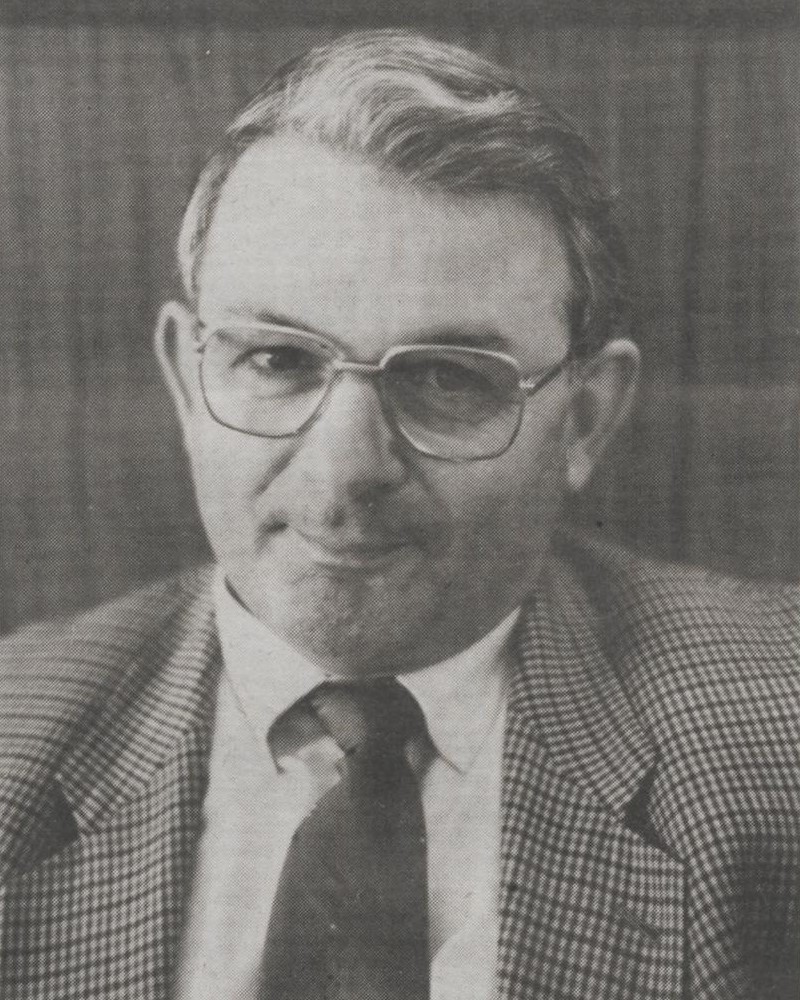
Bernard Leezer (57) lives in Aalten in the Achterhoek. Although he ran a butcher’s shop for twenty-six years, he does not really consider himself a butcher. He is a father of three sons and a daughter, and a grandfather of two. A conversation about meat, hiding from the Nazis, and football
“Both my parents have passed away. My father was a cattle dealer and my mother came from a well-to-do family in Wilhelmshaven in Northern Germany. She didn’t really suit my father at all. He was a stubborn man from Groningen who didn’t care much for etiquette. It caused friction. If my father came home and forgot to wash his hands before dinner, all hell would break loose. Of course, he wasn’t the type to just let himself be pushed around, so he’d fight back. And then my mother would say: ‘Na und wie bist du denn, wie bist du denn überhaupt?’ Mother spoke German at home. She spoke fluent Dutch too, but she hardly ever used it. I was raised bilingual.”
“My mother’s father was a horse dealer. She always used to go to the tennis court in a pony and trap. Anyone who did that back then belonged to the upper class. That’s why I always say my parents only met out of necessity. She fled to the Netherlands in 1932 with her two children—both my father and mother had been married before. My father had six children from his first marriage. Two of his children, one with a husband and child, were gassed. I am the only child from the second marriage.”
“My mother was a dominant woman. She always protected her own children, while my father’s children had to take a back seat. They had to fend for themselves from an early age. Of course, it wasn’t easy for them to accept a woman who wasn’t their mother either. Father was the kind of man who, for the sake of peace, would just think: Never mind. Let it be.”
“I was heavily influenced by my mother. If I wanted to go on holiday, she would say: ‘Du brauchst nicht so weit weg, wenn etwas passiert. When you are old enough, you will look for a wife and go to work.’ I became a butcher against my will. I actually wanted to be a pilot. Mother wouldn’t hear of it. So a butcher it was, but I’m not really a butcher at heart. I’m too emotional. I am against ritual slaughter because I believe an animal has the right to be stunned. God gave us the animals. Fair enough, but does a beast have to suffer that much pain before we scoff it down?”
“The first Jews to be rounded up were the Fuldauers. They lived right near us. They were taken away by PC Dijke from Aalten. He was a small, fanatical bloke. The Fuldauer family walked along packed to the rafters, and he walked in front, loosely wheeling his bicycle by his side, leading those people to the community hall. That’s where the Jews were gathered before being transported to Westerbork. People were standing outside the slaughterhouse, and they said: ‘Alright Dijke, you can keep that up all day, can’t you?’ Then my mother said: ‘It’s time. We have to leave.’ After the war, that Dijke fellow came into our shop once. I walked around the counter and said: ‘Get out, Dijke, and never come back, or we’ll cleave you in two.’ He was the man who took away the first Jidden from Aalten, and he just strolled in as if nothing had happened.”
“Kees Ruizendaal, nicknamed Zwarte Kees (Black) Kees)—also a policeman, but a good one—helped us find a hiding place. He was later executed by firing squad in Doesburg. First, I stayed with my half-sister Helga at the Klein-Entink farm, and later with my parents at Hendrik Groot-Nibbelink’s place on the Stroete in Lintelo. We were hidden with three orphans. They were practically children themselves. Drika, the oldest, was 26; Hendrik and Bernard were in their early twenties. To me, they are heroes. You know what would have happened to them if we’d been caught. They were Christian people. They did what they did out of love, not for the money. I think about that often. I find what they did incredible. Hendrik passed away last year. The vicar gave a beautiful sermon. I went and sat in the refreshment room. I felt that if I looked at the vicar, I’d get such a massive lump in my throat. I couldn’t well let myself go like that as a grown man, could I?”
“While we were in hiding, I used to go outside with Hendrik at night once it was dark. Next to the farmhouse stood an old apple tree. It leaned terribly and had to be propped up. Between the props was a tiny patch of land. If Hendrik had sown rye that day, for instance, I would go and sow rye on that little patch of land at night. He was my great role model; that’s why I was so heartbroken when the man died. He was like a father to me.”
“I spent a lot of time with the cows or with the horse. The Germans requisitioned Lies—that was her name—at one point. She was a right handful. She bit and kicked everyone except me. I could practically sleep right next to her. Hendrik managed to fetch Lies back because the Germans couldn’t control her. I was so happy she was back. At least I could cuddle her again. Drika used to play games with me. My father was too old to play with me. He was terrified that something would happen to me. I don’t know if he would have survived it. He was completely barmy about me. Later on, when I started going out and came home late, he could never go to sleep. He always stayed awake and would say: ‘Where on earth is that boy?’ My mother was more down-to-earth.”
“For a while—when it became too dangerous at Groot-Nibbelink’s—we also stayed with the Pennings family in Varsseveld. They were a very devout Christian family. During the war, he would go to Delft with a horse and cart to fetch glass. He sat on the box with the reins in one hand and a Bible in the other. Pennings had nine children. I often sit by the brook now, thinking: what must have gone through that man’s mind. He had to keep the peace in his family, keep us calm, and keep a cool head himself. The house was searched once at Pennings’ place. We were hidden under the straw along with sixteen other Jews and people from the underground resistance. One of those ‘blacks’ [NSB/collaborators] stood with his great boots right on my mother’s hand. He crushed her whole hand. Pennings was downstairs playing the organ: Abide with Me. Every time I hear that hymn, it takes me right back.”
“We hid with true Christians, and later I went to a Christian school. But I never felt the urge to become a Christian. My half-sister Helga joined the Reformed Church. Well, that took a few drops of water, but that was about the extent of it. Truly, you can have a stable full of Trakehner and Hanoverian horses, but if you put an Arabian among them, it stands out. You cannot deny who you are. The first thing people say is: ‘That’s a real Jewish trick.’ At home, my father and mother kept Jewish life alive for me. My mother wasn’t particularly pious. My father was orthodox. His whole life, even during the war, he never ate gasser (non-kosher meat). You are a Jid, and there’s no escaping it. I’ve always said: ‘I was born a Jid, and I’ll die a Jid.’”
“I couldn’t live in Israel because of the heat, but when I’m in Eretz, I love it. We go there regularly because our daughter lives there. When I go to shul here, I think pff, but there I think it’s wonderful. Afterwards, you stand around having a nice little schmooze with a group. You can’t do that here anymore. You could before the war. Before the war, about a hundred Jews lived in Aalten. After the war, we struggled to form a minyan. It’s just a completely different atmosphere. You can’t imagine walking down the street in Aalten wearing a kippah nowadays.”
“I can’t say I was frightened at the time. I can only remember that after the war, when I was at school, I was scared to death of the postman. I went to the Groen van Prinsterer school. It was an old-fashioned school with a very long corridor, with the toilets at the far end. If I came out of the toilet and Mr Terbrake was standing at the other end of the corridor in his postman’s uniform, I’d be rooted to the spot because I thought I’d seen a ‘black’. That’s what happens when you’ve spent years being told: ‘They’ll kill you.’ Terbrake would quickly go to Miss Jonker and say: ‘Bennie’s frozen at the end of the corridor.’ She would come and get me. She’d put an arm around me and take me back to class.”
“The Groen van Prinsterer was a fantastic school. It was a Christian school. I never once heard the word ‘Jew’ used as an insult there. It was quite a different story at the public school. I had to have remedial lessons because at eleven years old, I couldn’t even read or write. While in hiding, we did read little booklets, and when the war ended, my father said: ‘He reads like there’s no tomorrow.’ But you mustn’t forget that if you read me a booklet like that a thousand times, I’ll eventually know it by heart. At first, they fell for it, but the moment a different book was put in front of me, I couldn’t make head or tail of it.”
“During the war, I wasn’t aware that it was a matter of life or death. No one can tell me that an eight-year-old boy understands that. We were told: ‘You mustn’t go outside because people are walking around out there who will kill you.’ That doesn’t really sink in for a child. You can tell a dog a thousand times: ‘Leave that alone.’ And eventually, it won’t touch it anymore. But as for why it’s forbidden—it doesn’t understand that.”
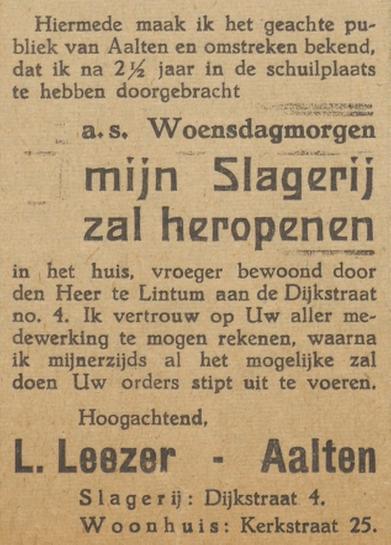
Aaltensche Courant, 4 May 1945
“During the final period of the war, we stayed with Hendrik on the Stroete again. We lived there for the first few months after the liberation too, because we no longer had a house. My mother went looking for her furniture. She managed to get a lot of it back. My father took out a loan from a Christian church. He was a bit casual about paying it back; years later, we still received a final notice. Right after the war, he put an advert in the newspaper: ‘After two and a half years in hiding, I am reopening my butcher’s shop’. My father wasn’t a good butcher. He was a cattle dealer. A proper trader. Very much a case of: one, two, up you get, just sign for that beast.”
“After primary school, I went to the technical secondary school. I didn’t want to go at all, but my mother said: ‘Du sollst ein Handwerk lernen.’ I ended up getting a whole load of diplomas. Alongside that, I always did a lot of sport: tennis, hockey, and football. My father wouldn’t give me money for football boots. ‘You’ll just have to earn it,’ he said. I always had to help my father, but I never got paid for it. My brother-in-law ran an emergency slaughterhouse. If there was an emergency slaughter in the middle of the night, he’d ring and wake me up, and I’d go and help him. I didn’t get any money for that either, but I did get the head, the tongue, the udder, and the liver, and I sold those. That’s how I bought my football boots.”
“I played as a semi-professional for De Graafschap. I moved from Aalten Football Club to Winterswijk Football Club. WVC was an elitist club. Because I went to school in Winterswijk and was in the school team, I caught people’s eyes. When I moved from Aalten to Winterswijk, I was called a ‘rotten Jew’. Why? I was turning my back on Aalten. WVC was an elite club, and they hated them. I was a really fast right winger. But I was very slightly built. They only had to tap my ankle and I’d go rolling over thirty-four times. Later on, I played centre-forward too. I was actually too small for it, but I’d always go tumbling to the ground, and that would get the referee on our side. I played two seasons for De Graafschap, until one day I was kicked out of the match by Dick Tol, nicknamed ‘the gnarled’.”
Leezer butcher’s shop, Peperstraat (1975)
“In the end, I ran a butcher’s shop for 26 years. Looking back now, I say: ‘I’d never want to do it again.’ A hundred grams of this, a hundred grams of that. Never again, though I did have some fun. Especially in the early sixties, we got a lot of German customers. Meat was cheaper in the Netherlands than in Germany. You had to be careful not to give the Germans preferential treatment, otherwise you’d get earfuls from the Dutch. Dutch customers were always served immediately by my assistant or my wife. Even if there were three Germans ahead of them, a Dutch person was served first. I’d make a joke of it and say: ‘Kurt, ich hilf dir’.”
“In the evenings, the restaurant owners from Bocholt would come in and order ten or fifteen racks of pork chops. There were a few customs officers who always came to get meat. They never had to pay. When they came by, they’d say: ‘Blimey, I’m on duty again tonight.’ And then in the evening, I’d get in my little Opel, take out the spare wheel, put the racks of chops in, and pop right over the border. I could always drive straight through. My wife knew nothing about it, and I thought: what she doesn’t know won’t hurt her. It was a time of adventure and wheeling and dealing.”
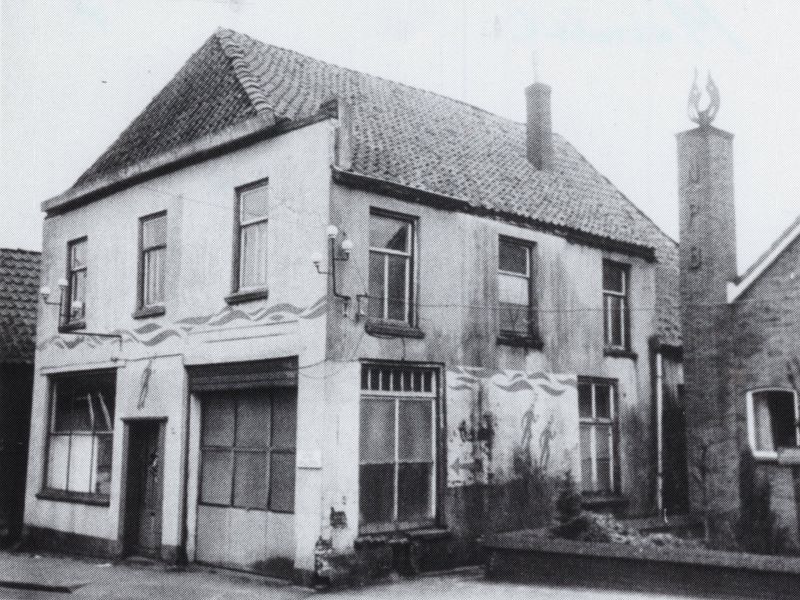
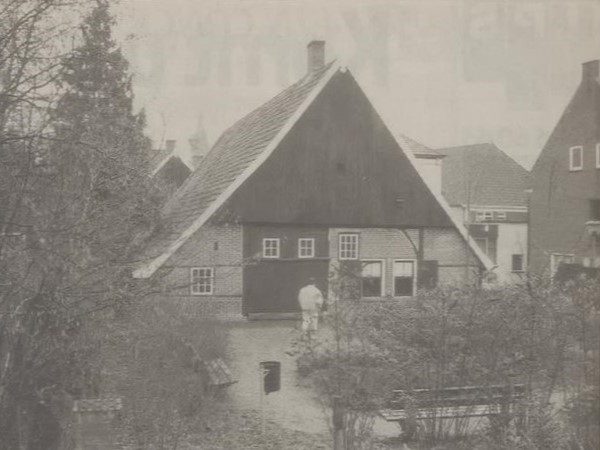
The old house in Prinsenstraat, next to the building of the Dutch Protestant Union (Nederlandse Protestantenbond), has been demolished. It was a very old house that had seen a great deal of joy and sorrow. It stood somewhat askew in relation to the street. One corner of the property stood more than half a metre closer to the street than the corner opposite it.
The old house was later extended with an additional storey and demolished in 1989. (Photo: H. ten Dam).
Now, a new building has taken its place. The street has undoubtedly taken on a more attractive appearance due to this redevelopment. The old house was in a state of severe disrepair. It must have stood there for around two centuries and was occupied by the Manschot blacksmith family from the end of the eighteenth century onwards.
Jacob Manschot and his family lived there in Achterstraat, which was then number 193. His wife, Elizabet Arentzen, was a sister of Roelof Arentzen, who later became the assessor of Aalten. Their son Gerrit Willem, born in 1802 and addressed in daily life by his second name, learned the blacksmith’s trade from his father at an early age and subsequently joined his father in the smithy. An older son in the family, Hendrik Jan, who was also a blacksmith, had a smithy elsewhere in the village.1 Then there was also a daughter named Elisabeth.
Double wedding
On 17 December 1833, celebrations took place in the house. Son Willem married Johanna Geertruijt Becking, known simply as Janna. Elisabeth also entered into marriage on that same day, wedding B.D.G. Muller. Muller was a merchant, and his trade was extensive. In addition to drapery and haberdashery, it encompassed grain, paint, hardware, religious books, musical instruments, hay, and straw.
Apart from the Manschot family, the Beckings and Mullers were also related to the most prominent residents, who, as assessors, municipal tax collectors, or “co-judges”, were able to exert a great deal of influence.
Schaars’s inn
Elisabeth left the house on Achterstraat, and Janna moved in with her parents-in-law. It was then number 228. Janna Becking was born on 24 November 1809. She was a daughter of Lourens Becking, a farmer originally from Varsseveld, and Willemina Geertruijd Schaars, the daughter of an Aalten innkeeper. Following his marriage in 1799, Lourens Becking had become the innkeeper there.
Schaars’s inn was located at the beginning of Peperstraat, on the corner of the Markt. It was run by a member of the Schaars family as early as 1748 and currently, after nearly two hundred and fifty years, still serves the very same purpose. Janna grew up there. She would have attended the village school next to the church, where schoolmaster Schotman taught.
Church organists
As mentioned, Jacob Manschot was a blacksmith, but on Sundays, he played the organ during services in the church on the Markt. When the Zelhem congregation had to appoint a new organist in 1829, Jacob was appointed to act as a judge. He had to assess the playing of the three applicants. In his report on the matter, he wrote: “…having given each of them the same Psalm and hymn, it appeared to me that the last to play possesses the greatest aptitude. Done at Zelhem the 24th of July 1829. J. Manschot”.
However, by 1842, he wished to step down, being 73 years old by then. In a petition to King Willem II, he requested that his son Gerrit Willem succeed him as organist. From that time onward, Willem Manschot served as the organist.
The family
Joy and sorrow alternated in the lives of Willem and Janna. Their eldest infant son, Jacob, passed away at the age of two. Their eldest daughter, Louiza, had been born in 1836. Elisabeth (Betje) followed in 1838. Two years later, Willemina Geertruijda (Mina) saw the light of day, and in 1842, a son followed who was again given the name Jacob. In 1844, Hendrika Johanna (Heintje) was born, and in 1847, Hendrik Jan, who was addressed by his second name. The youngest was Barend Johannis in 1850, or Bernard in daily life. Janna’s father had already passed away in 1830, prior to her marriage. Her mother survived her husband by twelve years and died in 1842.
When grandfather Jacob turned 78, his ten-year-old granddaughter Louiza came to him with a poem: “To greet you with my prayers, On this joyful day of today. Day on which it is your birthday, Grandfather, to me so dear and valued! Day on which I must reflect, What Heaven continued to grant me In possessing you, who always Stands by my side so affectionately.” The verse continued for a bit longer, followed by the signature: “Your loving Granddaughter Louiza”.
The girl also composed a poem on the occasion of her mother’s birthday: “Oh what a joy, dear Mother, Since today is your birthday. Grateful to the Preserver of All, I am gladdened on this day.” This daughter also knew how to express her wishes in poetic form for the New Year, composing a “New Year’s Wish to our highly esteemed Grandfather and dear Parents”. She decorated her wishes with borders of vines, flowers, garlands, or ornaments.
The elderly Jacob Manschot passed away in 1850 at the age of 82, after having been a widower for six years. Willem’s brother had also died by that time.
At the time the Manschots lived in Achterstraat, the house had a pointed roof. (Collection: E.M. Smilda).
Willem’s smithy
Willem Manschot dedicated himself diligently to his work in the smithy. For Kobus Prins, he made “a blade for the hoe”. He forged a “haar”, which is a small anvil used to sharpen a scythe or sickle, known as a haarspit. He made a “grepe” (manure fork), repaired the “rear axle of a wagon”, and fitted iron bands around the rims of wagon wheels. He delivered a “knife for cutting bread”, riveted “an iron onto a plate at the hearth”, and manufactured “an oven door” for L. Prins.
In between all these blacksmith duties, Willem also managed his property portfolio of lands and farms, which he leased out. Repairs had to be carried out there from time to time as well. In one place, “4 brass handles with their fittings” were installed; in another, the “latch was repaired, and a new plate bolt with a new catch” was made for the windows.
Sometimes customers paid him in kind, such as Kobus Prins who, for the benefit of Willem’s livestock, collected a few loads of hay from the Ruiterij, the pasture near De Pol. Others transported the harvested rye “from the Esch”. For Willem also ran a small farming operation of his own and owned a barn for his livestock on the opposite side of the street. Like every resident, he kept one or two cows; those of lesser means kept a goat, ‘the poor man’s cow’. In the slaughter month, a home-fattened pig would be hung on a ladder, which a day later was cut into pieces and placed into the salting tub, and even later hung from the kitchen ceiling, the ‘wieme’ (bacon rack). For the daily chores associated with this, he likely employed a farmhand or day labourer. Well-to-do citizens also kept a horse and had a carriage as a means of transport when going visiting.
Horses were no strangers to Willem either. How many had he not provided with new horseshoes in his smithy. Yet on one occasion, this proved fatal to him when he was kicked by a horse. The blow hit very hard. Severely injured, he was placed into his box bed in an unconscious state. His wife nursed him for two weeks, after which he died. Janna had become a widow, the children fatherless, and the church council had to look for a new organist.
The blacksmith and church organist G. Willem Manschot, who died in 1853 following a blow from a horse. (Collection: H. ten Dam).
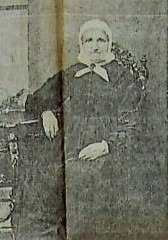
J.G. (Janna) Manschot-Becking (1809-1892) lived in Achterstraat for nearly sixty years. (Collection: H. ten Dam).
Extensive possessions
Now Janna suddenly stood alone with her seven, still young children. The eldest daughter, Louiza, was only seventeen years old, and little Bernard was just three. Initially, attempts were made to keep the business running with the help of a journeyman, but this proved impossible. Janna was forced to close the smithy.
It was fortunate that there were substantial property holdings. This enabled her to provide for her livelihood from the income they generated, and furthermore, to pay for her children’s education. None of the boys had been in a position to learn the blacksmith’s trade from their father. Consequently, this profession never occurred in the family again.
Since the passing of her husband, Janna kept the accounts for the leased lands and smallholdings. She maintained these records in a folio-sized “Land Lease” (Landhuur) book. In it, the lands were categorised into garden land, arable land, pasture, and uncultivated plots.
Garden land for vegetable plots
By garden land (hofland), Janna meant the relatively small plots situated close to the village that were used as vegetable gardens. In her accounts, she notes the names of plots, some of which are still known today. Most pieces of the garden land were divided into various parcels, and each parcel had its tenant.
There were four parcels on the “Boskerhof”. This may have been near ’t Boske, at the end of Richterinkstraat and on Varsseveldsestraatweg. The plot in “den Kraayenboom” likewise consisted of four parcels. That name is still known today for the land opposite the agricultural school on Lijsterbeslaan. Hendrik Jan Meinen was a tenant for ƒ 3.50, as was Lammert Prange. Willem Kasseler and Lammert Klompenhouwer clearly had a smaller piece, as they paid ƒ 2.00 and ƒ 1.50 respectively. Later, Janna used a garden there herself, as did Willem Huls, Mrs Hoftijzer, and Abraham ten Dam.
Then mention is made of the Knibbelweide, which must have been located on the Kemena. There were six parcels there. The total yield from this was ƒ 14.20 per year, though this had risen to ƒ 19.70 after 1883. Furthermore, there was a parcel in the Paardeweide leased by a man named Laak. The Paardeweide was also located on the Kemena, where the building of the Christian Comprehensive School stands today.
Finally, Janna’s bookkeeping records thirteen parcels of garden land on Het Smees. Gardening there were, among others, Berend Prins, Jan Kappers nicknamed “Hompele”, and Hendrik-Jan Schaapveld. Later tenants included Jan de Wikker, Kris Veldboom, Jan te Hoonte, and “the wife of the Wildeboer”.
The gardens on Het Smees frequently changed tenants. The names of Willem Walvoort, Jan Neerhof, and H.H. ter Beest also appear, the latter later leased to Fles, as well as D.J. Hoitink, G.J. Rots, and Hendrikus te Hennepe.
Until 1862, the garden land generated an annual rental income of ƒ 81.70. From 1863 to 1882, this was leased out through the mediation of notary B.A. Roelvink. The yield was then significantly higher, namely ƒ 98.05. When this notary passed away in 1882, he was succeeded by notary Maitland, but from then on, Janna made the lease agreements herself again. However, the income was then a few guilders less per year.
Not everyone paid their rent on time. It had been agreed that payment would be made on St Martin’s Day, which is 11 November, but some did not bring the money until the following year. Janna sometimes had to wait until May. In a number of cases, when the rental debt kept mounting, the tenancies of those involved were terminated. Some were three years in arrears.
The leased arable land
In addition to garden land, Janna also owned arable land that she leased out. These were often plots of one or more schepelzaad (an old unit of land area) in size. This arable land was located “at the front of the Esch”, by which is meant the plot where the Sonoco factory stands today on Damstraat. On the Smees lay 64.50 ares, and on the Boskeres 55.10 ares. In the Giezenbos “a molderszaad” (another old land measure), furthermore 50.90 ares were located there; the Draaiom arable land was 28.70 ares, which she sold in 1872 to the “Reformed Poor” (Hervormde Armen); the Holland 58 ares; the Neerhoffer Delle 42.50 ares; Smachtschot 65.10 ares, as well as another “molderszaad”. Then mention was made of Langevoren, nine schepelzaad in size, or 1.27.70 ha. Behind the Linde, Janna held more arable land, as well as the Peereboom piece, measuring 38.40 ares, and four pieces of Kempink, five schepelzaad on Prinsenkamp, and another plot located “on the Nes”.
Janna owned several of these lands jointly with her two brothers. Most plots were leased for a sum of money, but a few were also leased against the “third sheaf” (derde garf). This meant that the tenant owed a third of the yield as rent in kind. For the tenant, this had the advantage that if the harvest yielded little, the rent was also less.
The third sheaf concerned the rye crop, while sometimes the landlord/landlady (lessor) was entitled to some fruit from the orchard. In later years, the third sheaf was abolished on “Smachtschot”, which had been leased under those conditions by Lievers. The latter subsequently “bought the sheaves for 8 guilders”.
Janna also made use of services in return on multiple occasions. In 1880, “Derk Hoftijzer brought back a new water bucket from Bocholt”, and a year later, he sowed for her “a schepelzaad of spurrey … a schepelzaad of turnip seed… two schepelzaad of rye… carted soil for a day and two carts”. For all that work, ƒ 7.77 was deducted from the rent.
A certain Heuzinkveld manufactured 23 ells of coarse linen cloth for Janna in 1866. She had likely supplied the flax (or yarn). The service was worth ƒ 2.75, so Heuzinkveld still had to pay the remainder of the rent, being ƒ 1.75.
Pastures
As previously noted, a pasture behind the Pol, called Ruiterij, belonged to the assets of the Manschots. Janna also owned 1.14.84 ha of pasture on the Smees, which was (probably) sold in 1870 for ƒ 1390.00. Another pasture measuring 1.82.40 ha was located on Boterdijk in the Goor, which was also sold in 1870. The proceeds from this were considerably less, namely ƒ 600.00. From the estate of her brother Jan, Janna obtained a pasture “on the Broek”, while she also owned pasture and woodland in the Giezenbos.
Turf and peat land
The woodland and peat lands were not leased out. However, the produce from them could be sold privately or by public tender, such as standing timber. This also occurred with peat lands. The field would first be mown, and the top sod containing reed stubble and roots cut away. These were schadden (peat sods), which were dried and used as fuel. Turf (plaggen) was also cut from the heath-covered plots, which often ended up in the deep litter barn or stable and, mixed with animal excrement, was used as manure on the fields.
Janna owned woodland in the Goor, half of which was owned by her sister-in-law Elisabeth, who was married to Muller. Later, following the death of these parents, the half-ownership passed to the five children, the Muller Heirs.
Then mention is made of two pieces of woodland in the Schaarsheide, of woodland on the Kieftsheide, on the Hollenberg, near the Smeesweide (pine forest, coppice, and heath), and “copses in the Barloschen Esch”, peat land in Varsseveld, and peat sod land in ’t Goor, as well as in “Stapelkamps Bosch”, which she had inherited from her late brother Jan and had to share with her brother H.J. Becking.
In the year 1880, Janna sold ƒ 17.90 worth of turf and peat sods. Shortly beforehand, she had “sold wood to the Prange from Lintelo for 260 Guilders” from one of her smallholdings.
The smallholdings
The property of Janna and partners also included a number of smallholdings. The first mentioned is the Neerhof in Dale, of which D.J. Neerhof was the tenant. The tenancy was terminated in 1866 when the farm was sold.
Then there is the Lubbers smallholding in Barlo (Meinenweg), which was initially leased to J.H. Lubbers, but from 1867 to G.J. Mierdink for “sixty guilders and 96 eggs”. In 1877, the farm was sold to the tenant for ƒ 13,370.00.
Next is the Pennings smallholding (Hofstedeweg). Gerrit Jan Pennings is the tenant, who must yield annually for it “the sum of 48 guilders, 8 rent chickens, 96 eggs, and 4 pounds of flax”. In 1872, Pennings “departed for America”, and the farm was leased to Roelof Somsen for “56 guilders and 96 eggs”. Every now and then, Somsen performed services in return by collecting peat sods for Johanna, earning him ƒ 7.65, which was deducted from the rent.
The Slaa in the Heurne was also, together with her brothers, part of Janna’s property. Until 1868, G.J. Huitink was the tenant, followed by Jan de Breukelaar “Who must pay annually 40 Guilders and 60 eggs”. From 1880, the Slaa was leased to Wensink, who had to put down ƒ 48.00 and sixty eggs for it. In those years, Janna also notes: “sold a calf to Wensink for ƒ 5.50”.
Then there is the Slaa Schoppe, which was leased from 1852 to 1867 by J. Weggelaar, and thereafter by Evert Jan Beernink. The rent was ƒ 20.00. In 1874, Beernink scutched flax for Janna, which earned him 75 cents.
When her brother Jan died childless, he left Janna shares in three smallholdings, namely “Brijzak”, leased by farmer Smees, and “De Scheper” on the Haart, which was leased to Hendrik Jan Rensink for ƒ 65.00. This farm was sold in 1890, however. The third smallholding is Bekker on the Haart, which was leased for ƒ 40.00. This farm was also sold and, together with De Scheper, fetched ƒ 12,600.00. Finally, the Grevengoed in Barlo is mentioned, which consisted mainly of arable land. It must have been a large estate, located “next to Zwietink” and “near Wolterink“, thus on the Markerinkdijk.
In conclusion
Finally, a few notes on Janna’s children. Mina married J.G.H. Martens in Eibergen. She was widowed early and later, with those of her children who were still at home, moved back in with her mother on Achterstraat, after recovering over a period of six years from a nervous breakdown brought on by the death of her husband followed by that of her two youngest children.
After her mother’s passing, she moved to a property on the Markt, currently number 12. Louiza married Hendrik Beukenhorst, a goldsmith and silversmith in Winterswijk. At the same time, Betje also entered into marriage, wedding Abraham ten Dam, who later became a comb manufacturer. Her son Jacob suffered a very deep depression, presumably as a result of unrequited love, for which he had to be admitted to an institution in Zutphen for many years. He died unmarried in 1873. His brother Jan became a doctor in Winterswijk and married A.G. Tenkink of “Meenk” in Miste. Daughter Heintje became the wife of her second cousin B.H. Becking, who owned a ham smokery and wholesaled salt. He was consequently known as “Salt-Becking”.
The youngest son, Bernard, managed the Ten Dam & Manschot comb factory alongside his brother-in-law. He had a house built on Bredevoortsestraat, currently number 51. The Ten Dams lived across the street at number 40.
Janna continued to live on Achterstraat until her death and passed away on 22 January 1892. She was 82 years old.
The above is a summary adaptation of a family chronicle, derived in large part from the “Land Lease Book”, compiled by Henk ten Dam in Zwolle, entitled “Johanna Geertruyt Manschot-Beckings Landhuurboek vertelt (1799-1892)”, volumes I and II, 1985, available for consultation in the archives of the municipality of Aalten.
Footnote
This appears to be incorrect. Gerrit Willem’s older brother Hendrik Jan (*1799) did indeed also become a blacksmith, but he died a bachelor in 1839 in the house on Prinsenstraat, which was then number 228 (sources: ecal.nu and wiewaswie.nl). There was, however, another blacksmith named Hendrik Jan Manschot who lived on Kerkstraat, but he was a brother of Jacob and thus an uncle of Gerrit Willem. ↩︎
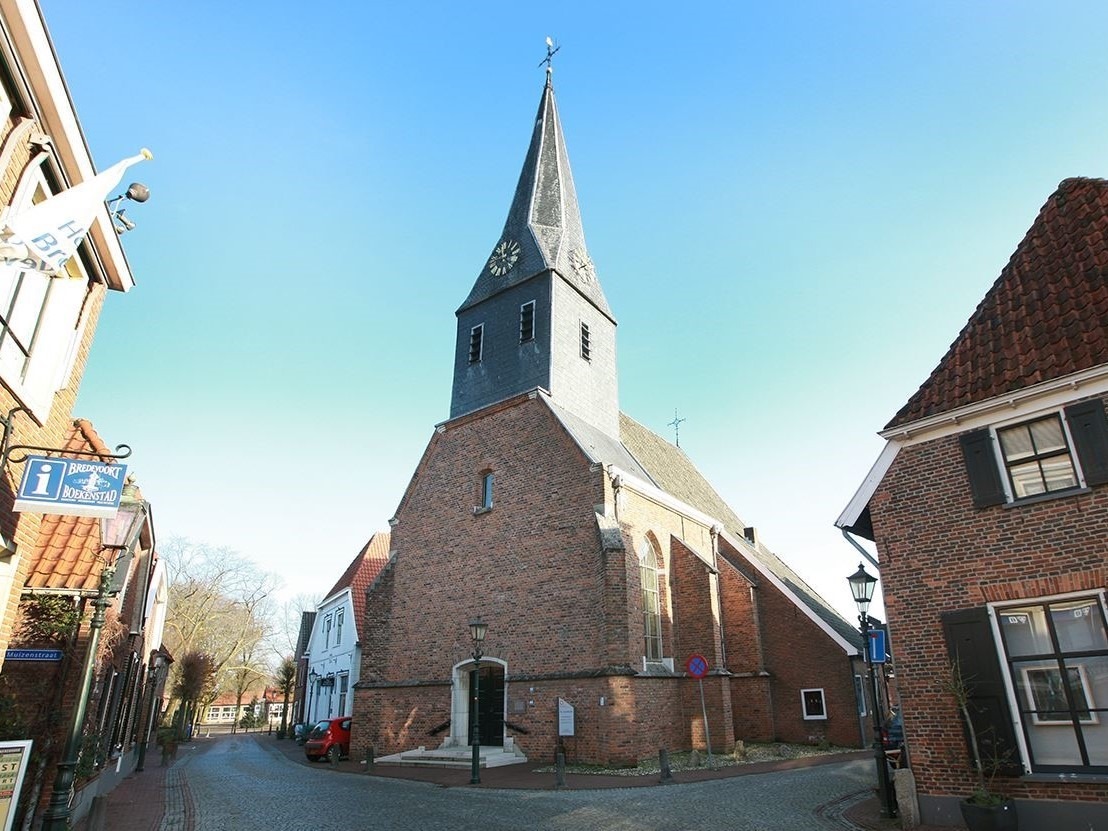
Kolossale pilaren ondersteunen in Aalten het gewelf van de NH St. Helenakerk, die met zijn gigantische omvang het centrum van het dorp moeiteloos beheerst. Koster A.J. Heusinkveld gaat mij voor naar het koorgedeelte en wijst naar de plafondschilderingen hoog boven hem. Ik zie Maria met het Kind, het hoofd van Christus, engelen, koningen en een voorstelling van de Heilige Geest. Ze sluiten niet op elkaar aan.
Large patches of white interrupt the paintings, which were discovered and exposed around 1900 and, according to Heusinkveld, were applied in 1471. He points upward again: “Look, it may say 1411 there, but do not let that mislead you. The man who painted that was probably drunk at the time and painted a ‘1’ instead of a ‘7’. At least, that is what my predecessor always used to say.”
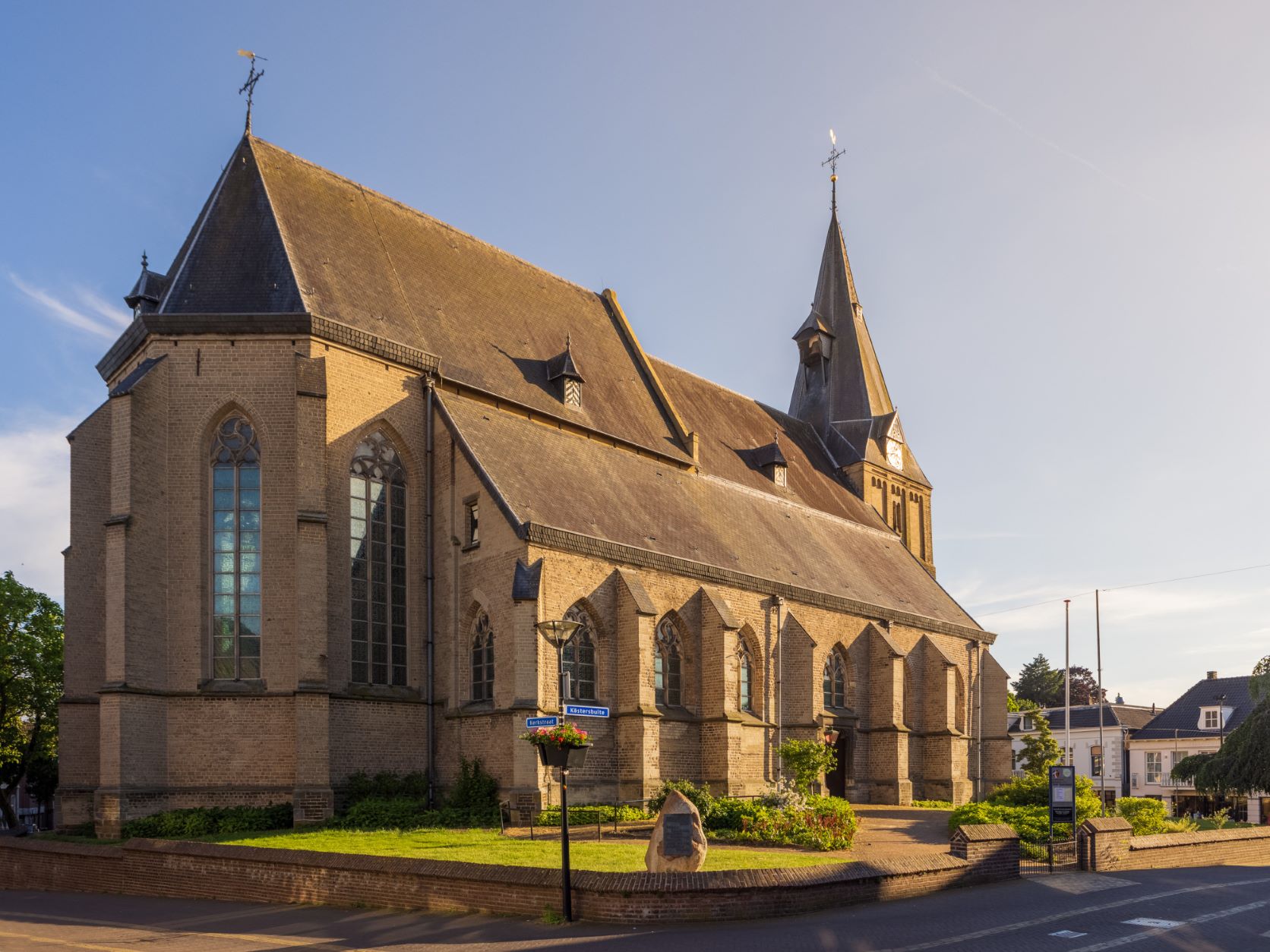
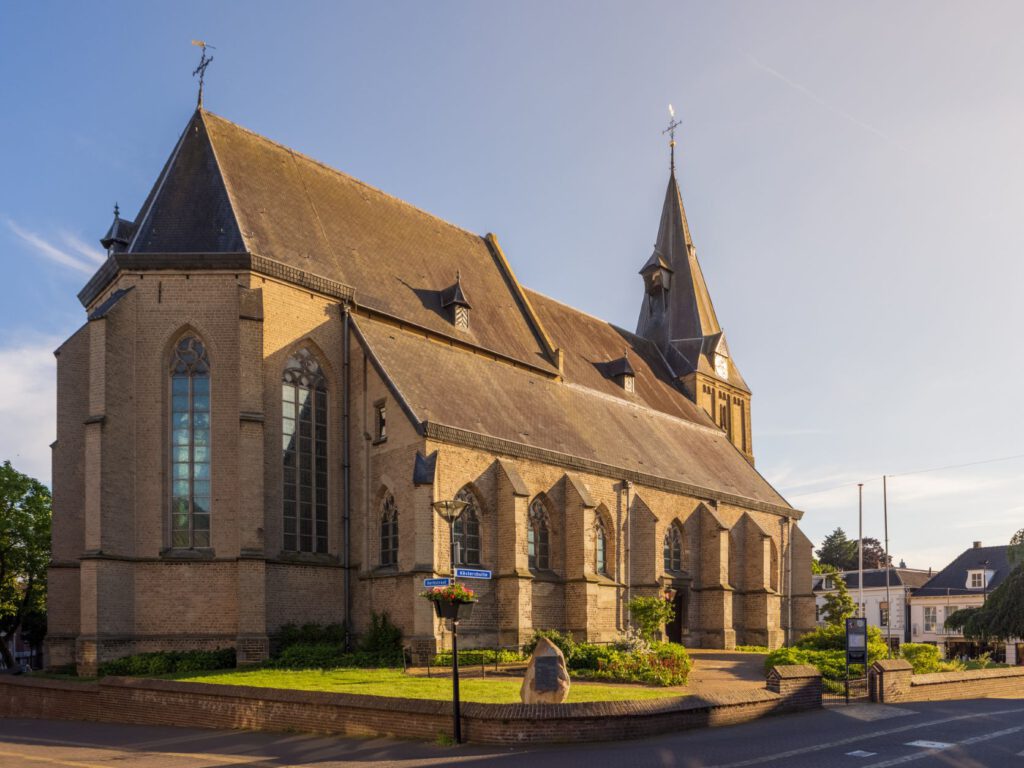
Old St. Helena Church, Aalten
Last Judgment
At the end of November last year, the centuries-old paintings on the wall of the Consistory were also uncovered and restored. They depict the Last Judgment, and it is quite a sight: angels lead the righteous to Jerusalem, while the wicked among us are taken to purgatory. Some are already sweating there in enormous iron cooking pots.
The church, featuring beautiful chandeliers, is packed with pews. “On Sundays — when we have three services — these are often all occupied,” says the sexton. “There is room for 1,000 people. Indeed, with three Reformed churches, one Roman Catholic church, our Dutch Reformed church, and a synagogue, many believers live in Aalten. Our village is also known as the Jerusalem of the Achterhoek.”“It is sometimes more than full here,” agrees Evert Smilda, chairman of the Aalten Antiquities Society, who is showing me around. “I was once running a bit late and asked the man by the aisle to move over a little. He did so, but with reluctance. ‘We are frugal with shifting,’ he said.”
Calling the sexton
The building, founded in 1100 and later altered in Gothic style, is open for viewing. Anyone who calls the sexton — 05437-72896 — or knocks on his door at Kerkstraat 2, will be assisted. “As long as people do not call me during dinner.” Aalten (11,000 inhabitants) is quite a pleasant village, with a Market square crowded with cars that was the first in Gelderland to be declared a protected village view. The square owes this primarily to the St. Helena Church and two old buildings that now form the town hall, with a rather unexciting piece of new construction next to it.
Old in years is Restaurant Stegers across the street. A centuries-old stone, originally part of the facade, is built into the terrace wall by the sidewalk. A deer can be vaguely seen standing on its hind legs. A word of 26 letters accompanies it. No one knows what it means. “We are facing the mystery of Aalten here,” says Smilda. “We do know, however, that such a standing deer was a symbol for the administration of justice. Well, justice may have been administered here in the inn in the past.” We continue through the village (a true regional center) with several old buildings such as Huize Ahof and the beautiful 19th-century mansion (now a guesthouse) Beekhuize.
The 18th-century Freriksschure behind the Frerikshuus museum is one of the few preserved farmhouses in the center of Aalten. Those who walk past it will soon find themselves on the car-plagued Market square, with the impressive Dutch Reformed St. Helena Church. (Photo Peter Drent bv)
Frerikshuus
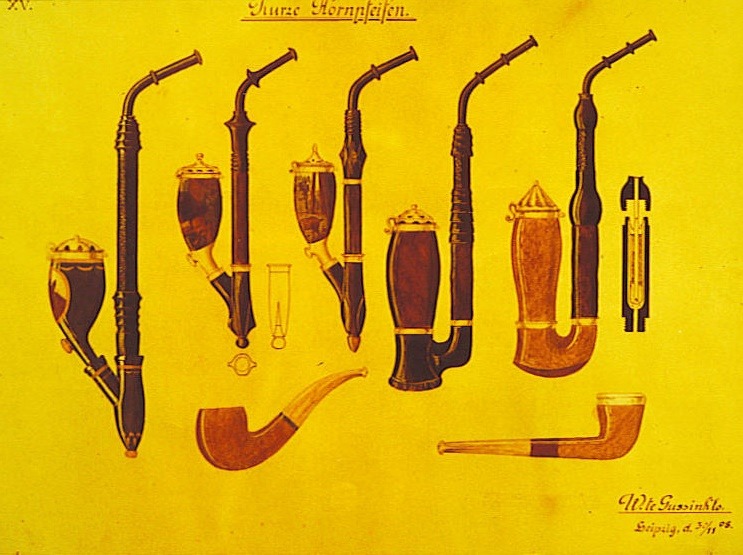
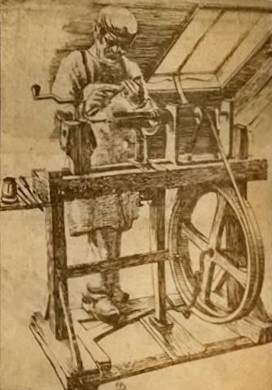
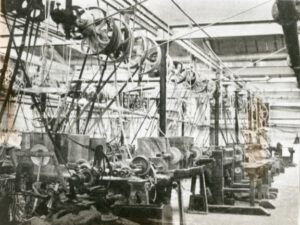
Finally, we arrive at the fascinating Frerikshuus museum on the Market square, which is filled with everyday objects: costumes, silverware, porcelain, and much more. One room is entirely dedicated to the horn industry, which occupied a unique position here for a century until the 1970s. Beautiful pipes, combs, and whatever else could be made from buffalo horns can be seen there.
In the large barn behind the beautiful house, various crafts are depicted, such as wheel-making. The museum is currently open on Mondays, Wednesdays, and Fridays from 2:00 PM to 5:00 PM. From March 31 to May 12, there is a special exhibition about the occupation and the liberation. Many people in hiding successfully sought refuge here in Aalten during World War II.
The village lies within the eternal charm of the Gelderse Achterhoek, with plenty of woods, thickets, enclosed fields and meadows, and quiet lanes.
Bredevoort
Two kilometers from Aalten lies the thousand times more beautiful town of Bredevoort, with its tower mill beckoning from afar, its ancient St. George’s Church, its quiet streets, its endearing old buildings, and its sense of nostalgia. At the last moment, I renew my acquaintance with baker Ben Helmink, the chairman of the local tourist office (VVV), who tells me that restoration work is still ongoing. “Huize St. Bernardus”, he says, “that large building from 1764 on our square ‘t Zand, has just been completed. You won’t believe your eyes. It is truly beautiful now. And so dignified! Bredevoort becomes more beautiful every year. That is it.”
Thanks to the research activities of the Aalten historian E.M. Smilda, many historical details regarding mail delivery in the municipality of Aalten have come to light. A look back at the history of the postal system reveals that in the early 19th century, couriers and messengers were responsible for delivering letters and messages for both the government and private individuals.
At the exact location where the then-new post office opened on the Peperstraat in 1986, Hendrik Jan te Gantvoort and Garret Jan Hoopman started a “mail coach service” to Zutphen in 1812.
Cart driver
The ‘old’ post office on the Haartsestraat
It is known that in 1742, a certain Hendrik Hoopman was a “cart driver” and drove to Zutphen twice a week. At that time, Hoopman also lived in the Peperstraat, a location that has played an important role in the local postal system throughout the centuries. In 1784, there is mention of a “mail coach” that traveled via Zutphen to Aalten, Bocholt, and Borken twice a week. On two other days, the route was traveled in reverse. Letters were carried for a stuiver and delivered to “Roelof Arentzen in De Klok.”
The aforementioned Te Gantvoort drove his mail coach via Zelhem and Hengelo to Zutphen. In 1827, Jilles van Buul was the first “distributor of letter mail” appointed by the municipal council. In 1832, the council appointed Jan Berend Lohuis as the first messenger. He handled the mail to Groenlo. Gerrit Schotman was his successor in 1843. Gerrit Jan te Tuunte was tasked with the mail route to Winterswijk.
With the introduction of the Postal Act in 1850, the municipality’s involvement with the postal system ceased. Schotman lost his job, and Te Gantvoort emigrated to America with his family in 1854, at the age of 60.
Frequent moves
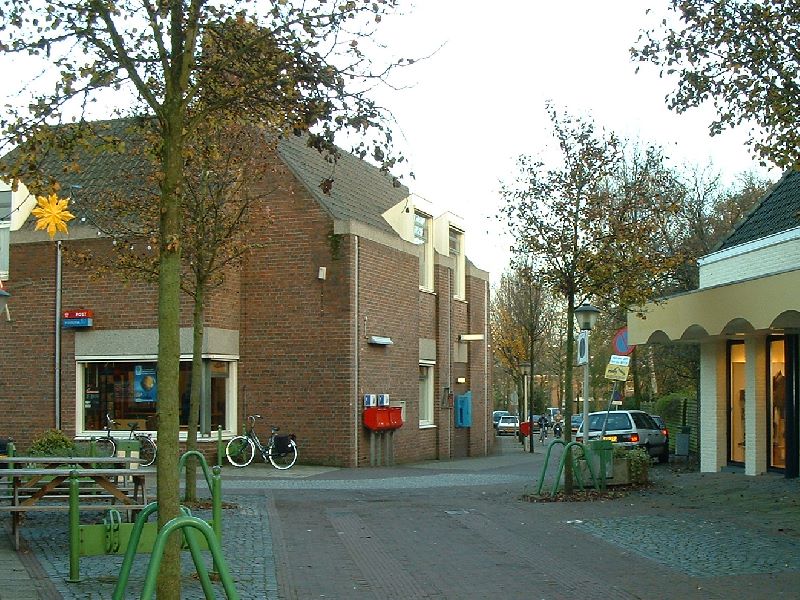
The ‘new’ post office on the Peperstraat
The Aalten postal service would move numerous times. For instance, operations were conducted from a shed in the Dijkstraat, from the Landstraat (later Ebbers shoe store), the corner of Kerkstraat-Peperstraat (later fashion house De Postiljon), and from 1922 in the former mayor’s residence, the so-called Tackshuis, on the Haartsestraat. On June 26, 1986, the postal services exchanged that location for a new building on the Peperstraat.
Approximately 20 years later, the post office in Aalten was closed. Since then, the residents of Aalten have been able to visit the Primera on the Bredevoortsestraatweg for their postal matters.
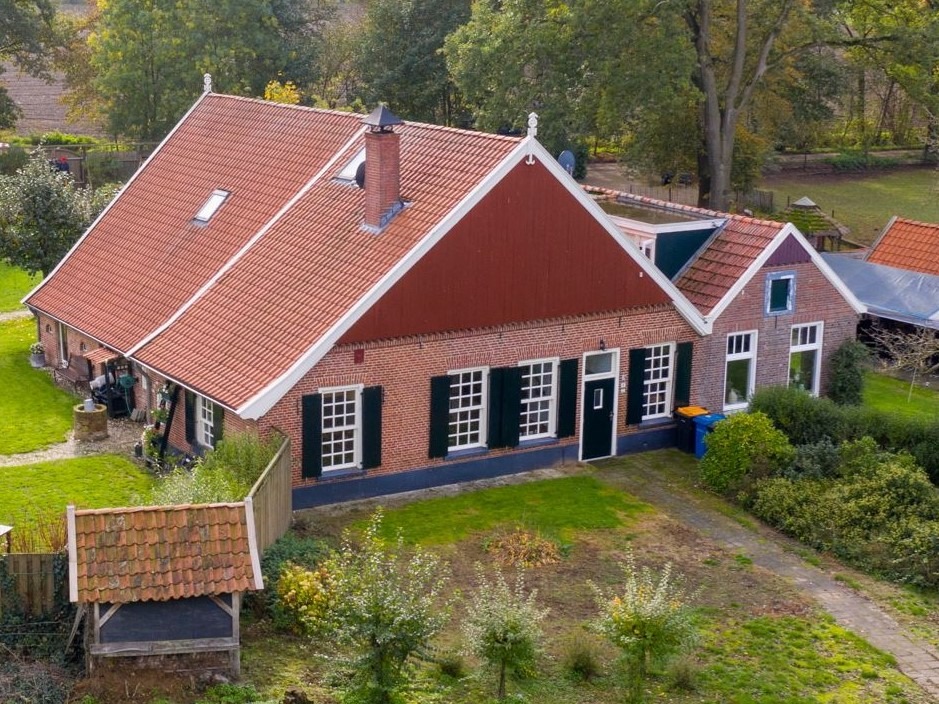
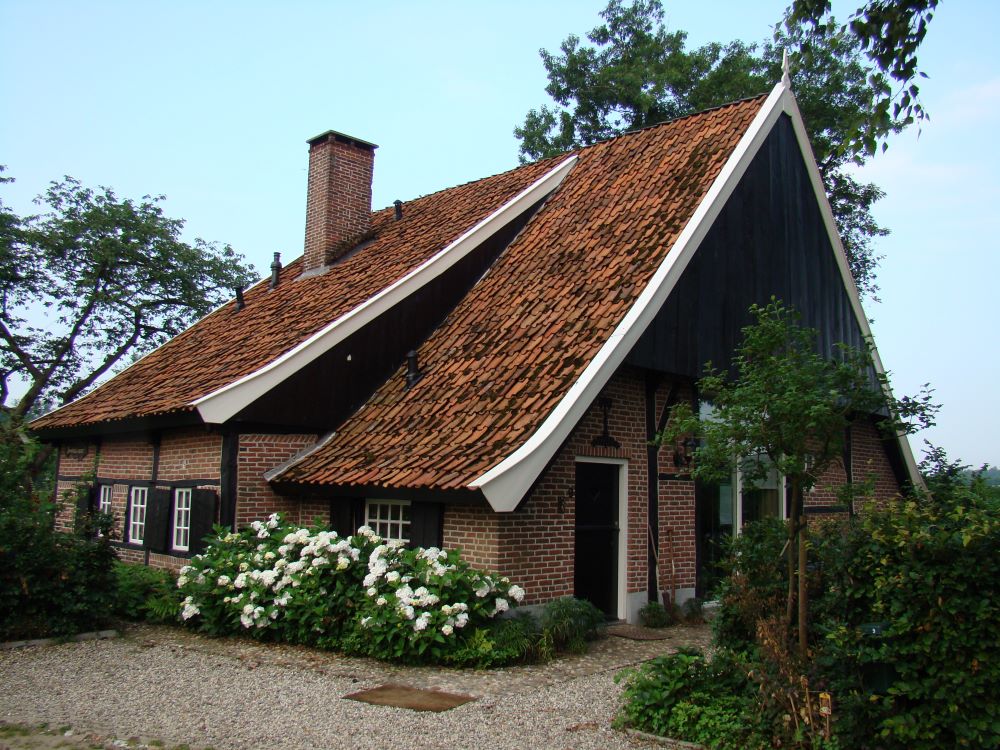
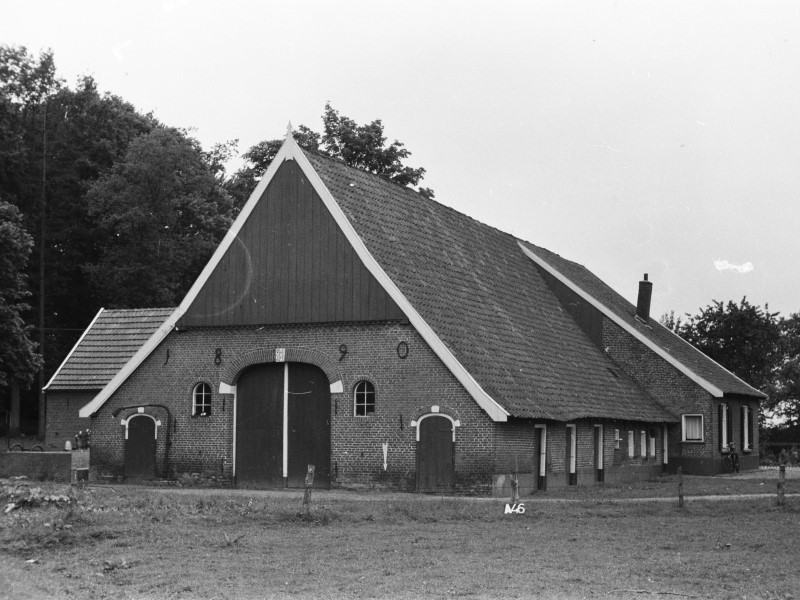
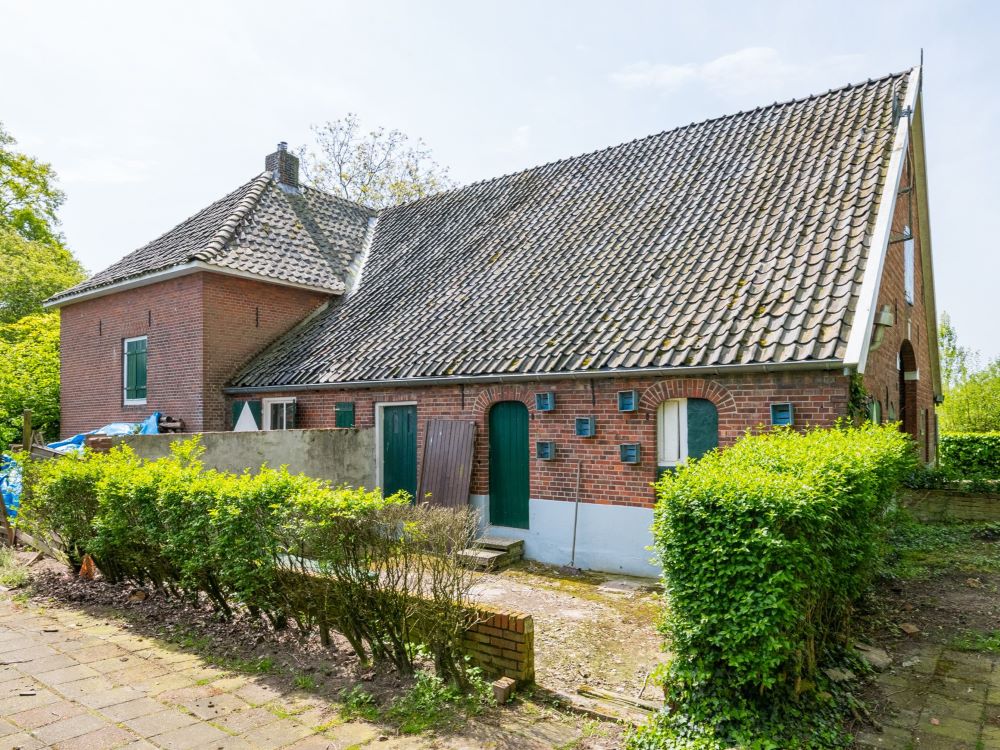
Aalten has a large number of farms with their own names. In the 1967 address book of the municipality of Aalten, about 480 are mentioned. Almost all of these names are unique. To avoid confusion, it was logical to give a farm a name that did not yet exist. However, one finds, for example, the Oude Loo and the Nieuwe Loo, Groot Kampe and Klein Kampe, even ‘t Paske, Groot Paske, Klein Paske and Nieuw Paske. These are often farms that previously formed a single homestead but were split into parts during division among children. Names with “Olde” or “Oude” then point to the original house.
When one examines those names, an interesting discovery is made. They can be divided into different groups. For instance, there is a group of names from which one can deduce what the vegetation around the yard used to be like and in what kind of environment the farm was established. Another group points to the trade that was practiced there in the past alongside agriculture and livestock farming. Many farmers, and especially the small-scale ones, had enough time to do something on the side to earn a bit extra, which was often necessary.
The practice of giving names to farms is very old. In the verpondingskohier (tax register) of 1647/50, the persons who had to pay the ‘verponding’ (a land tax) are recorded under Aalten, as well as under Bredevoort. But under the rural districts, the names of the farms are mentioned, followed by the names of the residents. Thus, we have a list of homesteads that existed at that time. Many of the current names already appear in it.
One must possess a very great imagination to be able to picture what the Aalten landscape looked like centuries ago. Nine-tenths of the land consisted of heath, forest, and swamp. The cultivable area was small and was only used for growing vegetables and a few cereal crops. Most farms were small: ‘stedekes’. Division of the common lands, artificial fertilizer, and better drainage put an end to the ‘prange’ and ‘marode’ (hardship and misery) of the farmer.
The following names require an explanation: Bokkel, called Buclo in 1284, beech forest. The Walfort was previously called the Waldenvort, a ford (through the Slinge) near the Wald (the forest). Similarly, Walvoort on the Haart, with a ford through the Keizersbeek.
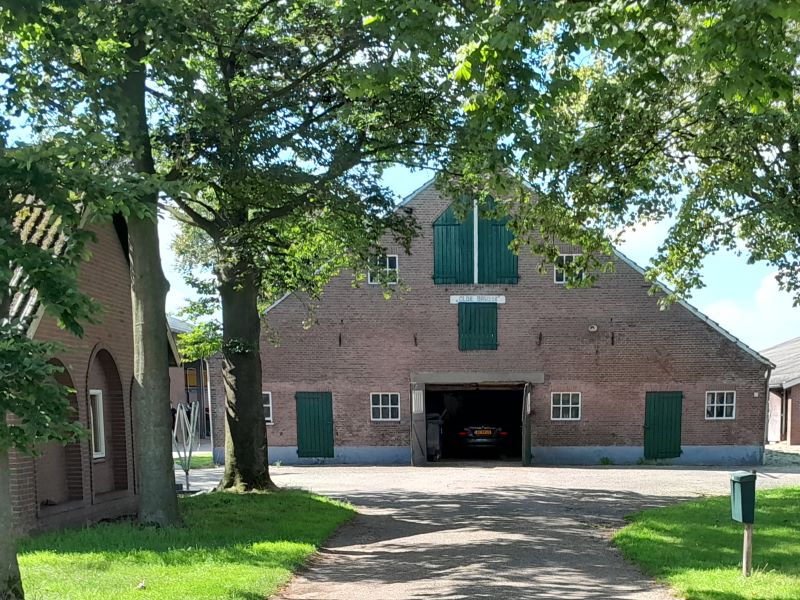
’t Olde Brusse, Lintelo
The name Voorst (from forestis) was used for a forest in which hunting was not allowed; it was the private hunting ground of the king or the lord. The site of the Snoeijenbos was cleared in the forest. Brusse is formed from: Brusch, brushwood, ‘t Hagt and the Heegt: forest of low wood, perhaps consisting of hawthorn bushes.
The Slehegge may recall the blackthorn, ‘t Heggeltje: a small ‘hagt’. The Hakstege was located on a narrow path (stege) through the ‘hagt’. The Rieste owes its name to the brushwood (rijshout). The Heisterkamp was established on a site where much brushwood grew.
In 1386, the name Varenvelde appears, and later also the Verrevelt, which is now the Vervelde. The Veernhof also originated in a field full of ferns. The Tente owes its name to the ‘tente’, the common tansy. The Greute recalls the ‘gruit’, the bog myrtle, with which beer was fermented and which grew on marshy ground, as did the reed, which is found in the name the Riete. Waste uncultivated land, ‘vage’, is found in Vaags.
One should not have a grand conception of these heights. An elevation of half a meter was already called a ‘bult’, a ‘horst’, or a ‘heuvel’. These heights offered no protection whatsoever against the damp environment. The houses were very damp.
Names like De Bulte, Bultink and De Heuvel speak for themselves. De Brink (brinc) was a grass-covered elevation. De Bree (from bride) is considered a field on the ‘es’ (open field). Drenthel (originally Drenthelo): forest on an elevation. Haartman and Haartelink: a ‘haart’ is a high-lying heathland. Hengeveld (heng, slope), Hillen (hil, hill), Hoopman, the Klinke (hilly heathland with puddles and pools here and there).
De Horst (an elevation covered with low wood), Leemhorst, Seinhorst, Stokhorst and Winkelhorst. Leeland (lee, hill, also a place of judgment), the Limbarg (loam mountain?). De Pol: a small sand hill that stood out like an island above the surroundings. Pikpolle (pec, poverty): a meager hut on a ‘pol’.
Tammel (in 1384 Tanbulen): pine forest on a ‘bult’? Hondorp: village, mound, elevation the size of a ‘hont’, a unit of area. The Westendorp also points to an elevation. Wierkamp: ‘wier’, ‘wierde’, elevation protruding above a wet environment.
Farms located in or near a swamp
The largest part of the municipality of Aalten used to be swamp. Only the Bocholt–Vragender ridge protruded above the marshes. These ‘broeken’ (marshlands) were created because the small rivers the Slinge, the Zilverbeekje, and the Keizersbeek could not sufficiently drain the water. That is why so many farms have a swamp name, such as Goorhuis, Goorman, Goorzicht, Moorveld, the Stroete (marshy wasteland), Veenemaat, Groot and Klein Veenhuis, ‘t Veentje, Wijnveen (‘winne’ farm, farm in the peat), Hagenbroek (a marshland with hawthorn bushes), Kortenbroek (a marshland with short grass and therefore infertile land), the Woerd (woert, low-lying land).
Bolandsweide (bol, soft, marshy, mud). The Nonhof (in 1281 den Honhof) and the Hennepe (in 1284 Honepe), both names formed from “hoen” and “huun”. Luiten, popularly Luten, was low-lying poor land, ‘lute’, while Maris represented much the same: swamp. Glieuwe: ‘gliede’, black shiny soil, peat. Somsenhuus: ‘somp’, marshy land. Pietenpol (in 1640 Pytenpoel): ‘pitte’, pit, hollow, thus a pool in a low place, De Put (hollow, pool. ‘t Slaa: ‘slade’, heath pool, swamp. Te Sligte (in 1384 Schlichte): flat swamp. Mager: poor, meager land. The Navis possessed a damp meadow; ‘nate’, wet and ‘vis’, Wisch, ‘wiese’, meadow. Near Amerongen, the medieval residential tower the Matewisch still stands.
Pietenpol, Haart
Camp names
Stapelkamp, Heurne
A number of names end in -kamp. Originally, the ‘kampen’ were small pieces of land that had been cleared of brushwood and trees in the forests, thus reclaimed forest. Later, the word ‘kamp’ acquired the meaning of field.
Only a few names recall the reclamation of wastelands. Nijland, Nijveld, Nijhof, Nieuwkamp, Nieuwe Weide. The Bijvanck, what was ‘caught’ or taken additionally. Te Brake also points to reclamation, the ‘breaking’ of the wasteland. Ruwhof: ‘rude’, ‘rode’, reclaimed land.
Farms that recall passes, gates, tolls, etc.
A ‘pas’ is a passage in a ‘landweer’ (defensive earthwork), a wooded bank. The resident of the nearby farm had to ‘oppassen’ (watch out), supervise the persons entering. Such a farm sometimes bore the name “Pasop”. Along the Romienendiek, for example, lie the Paske, the Pasop and the Paskerhut: the residents had to keep an eye on the persons who entered the ‘marke’ (common land) through the Wolboom and the Zwarte Veen. On the border with the Varsseveld area near the Varsseveldseweg, there is also a Pas. On the Varsseveld side, the Loerdijk and the Kijkuit are located here. The ‘marken’ were well protected.
Among those who also had to take the ‘marke’ under their care was the resident of the Markerink, formerly called March-ward-inck. A ‘werde’ was a watch post, a place where one had to supervise the intruding unsavory elements. A similar activity was expected of the Ligterink, which in 1435 was called Licht-werd-inck: the watching apparently felt rather light there. The duty of keeping watch also lay with the Kuier and the Kuierman: ‘koeren’, ‘kuren’ meant “looking out”.
Did the ‘schutte’, who had to seize (schutten) the livestock from another ‘marke’ that had intruded into their own ‘marke’, live on the Schuttenkamp, and did such a person also live on the Man-schot-weide? Recalling the tolls are Slotboom, the Stokkert, ‘t Bonte Hek, Klaphekke, ‘t Tolhuis, Tolkamp and Tolder (toll collector).
Memories of the church
De Pater, ‘t Klooster (named after the Schaer monastery), Kerkhof (a farm of the church), Kerkkamp, Neerhof (den Heerhof, inhabited by the monks), De Kloeze, hermit, perhaps also Klaus. Kosters custerie: the proceeds of this property were for the sexton.
Beestman (herdsman), the Scheper (shepherd), Sweenen (swineherd), Fukker (breeder), Peerdeboer (horse farmer), ‘t Villeken (where dead animals were skinned and the hides were tanned), Baten (‘beten’, the tanning of hides). The Brasse (brewery), Pakkebier (‘backe’, also brewery), Schenk (public house, tavern) and Slikkertap (a tap in the ‘slik’, swamp).
Brethouwer (should we interpret ‘bret’ here in the sense of board, thus someone who made boards?), the Klumper and Klompenhouwer (‘houwen’ is chopping or carving), Kolstee (place where charcoal was burned), Kuiper (cooper), Draaijer (turner), Kappers, Kleuver (recalling the chopping and splitting of wood), the Smid and ‘t Smees (formerly Smedeserve). Papiermolen, the Olde Mölle, ‘t Olde Mulder, the Görter (groat-maker, hulling miller), Te Roele (in 1640 ten Rule – ‘rullen’, hulling of grain, hulling mill).
Bouwhuis Wever, ‘t Klooster
Den Blauwen (blue-dyeing of linen), the Wever (weaver), Bouwhuis Wever, Weversborg, the Pellewever (weaver who wove finer goods, such as damask and table linen), Schreurs, Snieder and Snijdershuis (tailors). Kremer (peddler) and Klodde (ragman). Speelman (someone who cheered up the parties with a musical instrument) and the Piepert (piper, flute player). Krieger (inhabited by a soldier? In 1640, a soldaetencamp also occurred in Barlo).
Farm names ending in -ink etc.
About forty farm names end in -ink. These largely point to the possession, to the estate of a certain person. They are mainly composed of a personal name + -ink. Lists of proper names that occurred in the Middle Ages have been compiled from all possible archival documents, and based on these lists, a number of farm names can be explained.
Hoenink, Huinink and Hunink were located in a ‘hoen’, a ‘huun’, a swamp. Another explanation that we must take into account, according to the CBG Center for Family History, is that names like Hoenink and Huinink go back to the Germanic personal name Huno.
However, there are a number of names that cannot be traced back to personal names. They clearly refer to something else. These are: Bekink (located near a brook), Bultink (located on a ‘bult’), Doornink (located in or near a thorn forest), Eekink (located on a site with oaks), Essink (located on an ‘Es’), Heijink (located on the heath), Kempink (located near or in a ‘kamp’), Haartelink (located on a ‘Haart’). Rengelink can indicate a “rinc”, which was a place of judgment. On the Borninckhof, the Haartse Wetering originates, so there are springs there. On the former Richterink, the judge held his proceedings.
There was a time when the meaning of the suffix -ink was no longer understood. People then began to form names with “stedeke” and “goet”. Thus we find, for example, Heijnengoet, Goossenstedeke, etc. In later usage, the words ‘stedeken’ and ‘goet’ were omitted. Freriksgoet became Freriks, Rutgerstedeken became Rutgers. Here again many farm names formed from personal names: Freers, Freriks, Bullens (from Bullo), Ebbers (from Ebbo), Goosen (Goosen, Goos), Heinen (Hein), Lammers (Lammo), Lievers (Lieven), Lindert (Lindert), Lubbers (Lubbert), Reinders (Reinder), Rutgers (Rutger), Wiggers and Wiechers (from Wigger), Wubbels (from Wubbel), Wolters (Wolter) and Rikkert (Rico).
In addition to the farms classified in the groups above, there are a few others that deserve special mention: the Tuunte was surrounded by a ‘tuun’, a woven fence, as were the Vreman and the Vreveld. The Zigtvrede had some preferential rights in the annual distribution of the ‘marke’ lands. One of these farms was called Seegvreden in 1640, named after the ‘seege’, the goat. The Hegge was surrounded by a hedge. The Sonderen also had rights; a part of the common land could be used for private use. That part was separated (afgezonderd) from the ‘marke’. The Meijnen was also part of the common ‘marke’.
The Haverland and the Haverkamp had the duty to supply oats (haver) to the lord or church, etc. On the Hemelmaat, justice was administered; a ‘hegemael’, a ‘heimael’, was a space surrounded by a hedge where a ‘mael’, a court session, was held. The Akkermaat owes its name to a meadow that could be mown in one day, and the Maandag to the piece of land that could be plowed in one day with the shared livestock. A former name would therefore have been: Mendag. The Hogewind should actually have been called the Hogewend, because this was the high end of the land where the plow was turned (gewend).
The Grotenhuis provides information about the size of the house and the Nieuwenhuis (in 1640 Nijenhuis) points to a then newly built dwelling, just like Nijboer. The Lankhof and Scheel indicate the shape of the land: long and crooked. The Korten (in 1640 Kortenstedeken) had only a short piece of land. The Heurne had the shape of a horn, a tapering piece of land, as did the Timp and the Timpert. Sad was the state of the Prange, the Marode and the Drommelder, which three names can all be translated as misery.
The Smol was “small and insignificant”. Could the Huikert have been a hay meadow or is it a distortion of the popular name Huik for Hugo? The Botervat: butter meadow? The Westendorp, the Oosterbosch, the Oosterhoeve and the Oosterman derive their names from the cardinal directions towards which they are oriented. Agriculture is indicated by: Bouwlust, Bouwhuis and the Bovelt (building field). Is the Hillo (Heiligelo?) a memory of paganism or was it a ‘lo’ on a ‘hil’ (hill)? The Leste Stuver was formerly an inn near Bredevoort where traveling people could squander their last penny.
Boerkoel, G.A.W., The Names of Aalten’s Farms, published in the Oostgelders Tijdschrift voor Genealogie en Boerderijonderzoek (1984, nr. 2, pag. 1), edited and supplemented by Remco Neerhof (Old Aalten). Some farm names appear more than once in the municipality of Aalten; in such cases, the hyperlink provided usually refers to the oldest known farm.
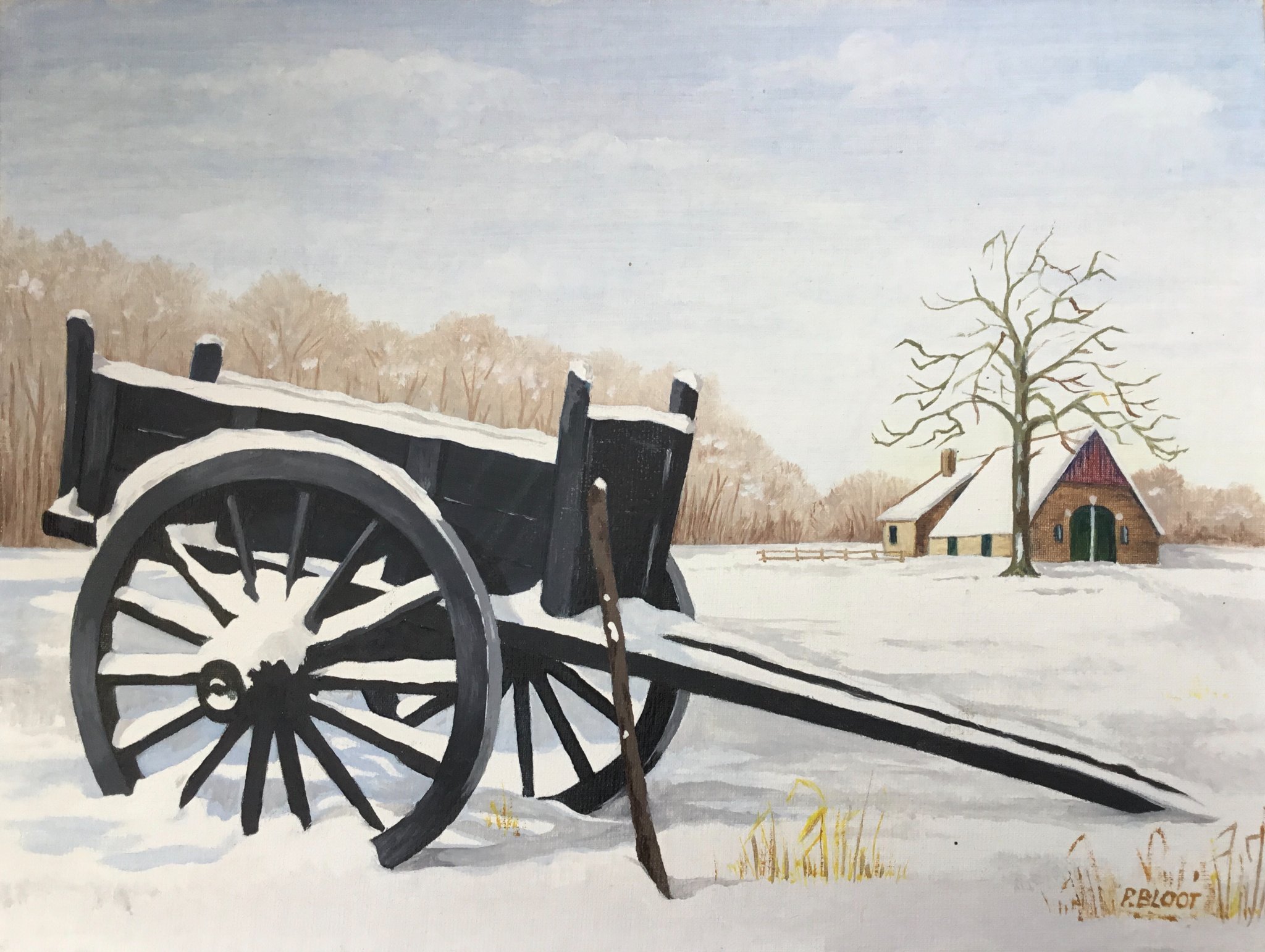
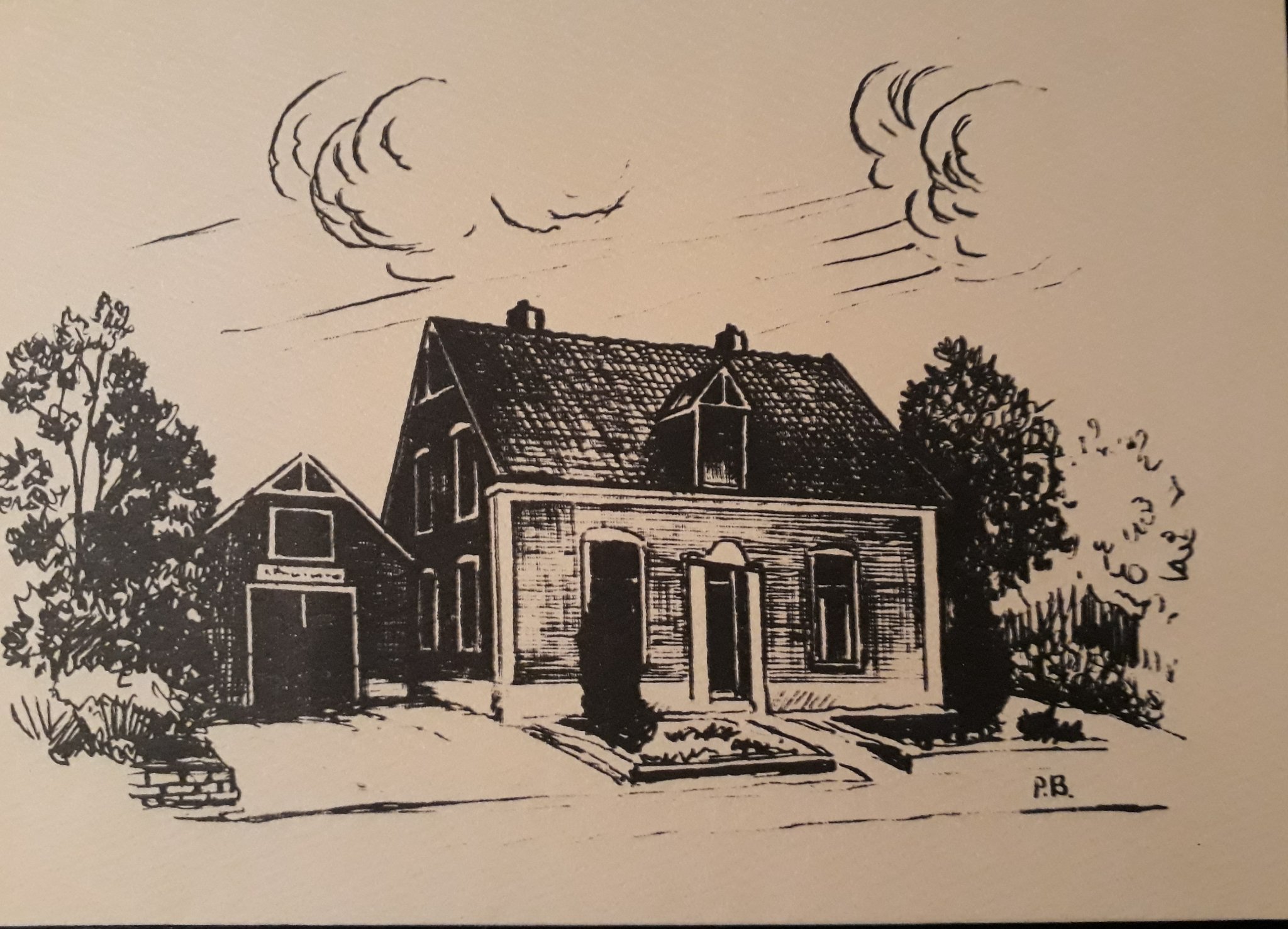
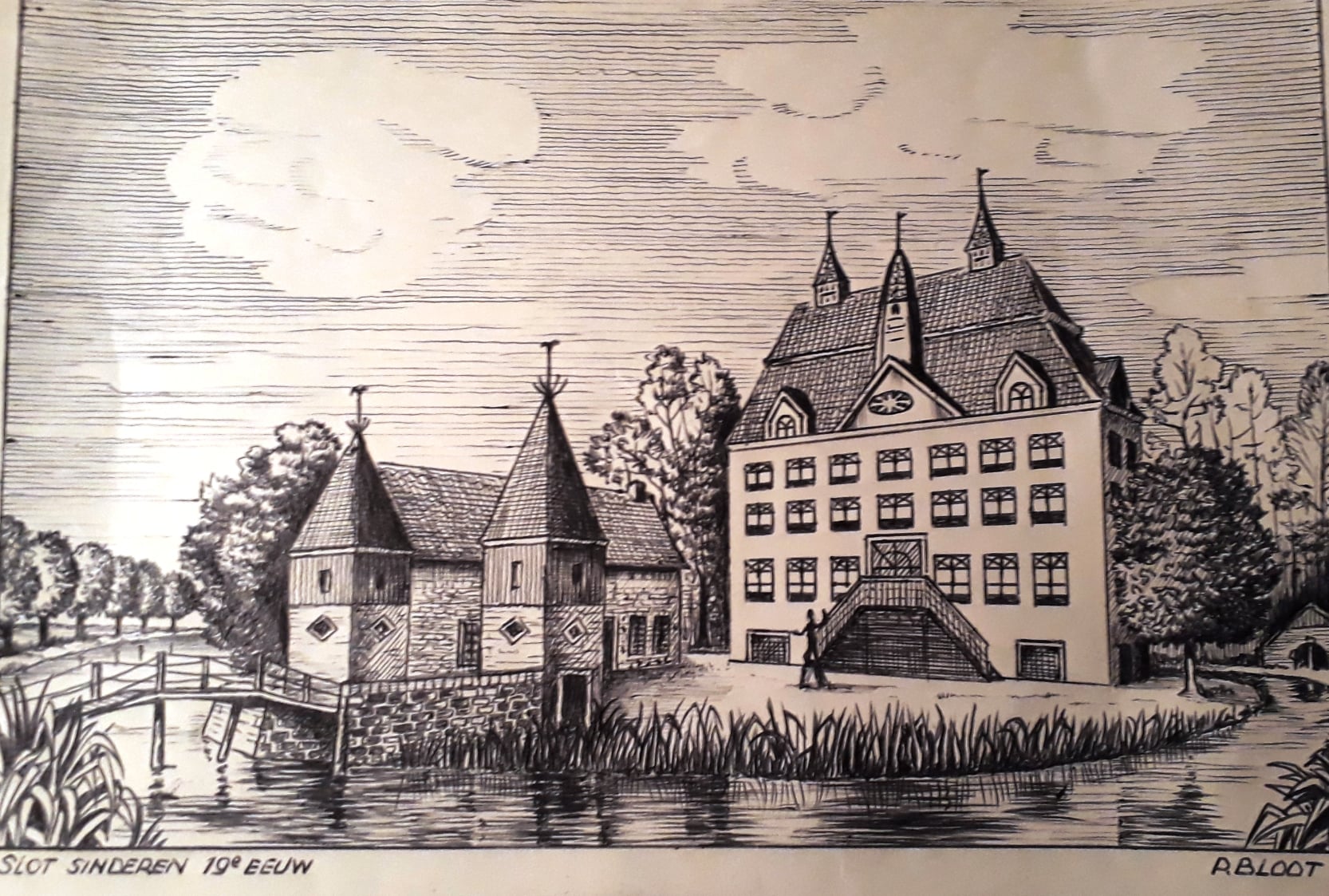
Pieter (Piet) Bloot (1924–1982) came to Aalten from the bombed city of Rotterdam in the summer of 1940 as a sixteen-year-old boy. On the initiative of the Calvinist (gereformeerde) minister Th. Delleman—formerly a minister in Aalten and later in Rotterdam-Kralingen—an appeal was published in the Aalten church magazine to offer Rotterdam children from affected families a carefree summer holiday. Piet was one of the fortunate ones.
What began as a holiday turned into a five-year stay. During this period, Bloot worked in the horn industry in Aalten. Because he had a passion for drawing, he returned to Rotterdam after the liberation, where he studied commercial drawing at the Academy of Fine Arts.
However, Piet could no longer settle in Rotterdam and returned to the Achterhoek region at the end of 1947. He went to work for the electrical installation company ERBA Van Lochem in Aalten. In September 1949, he met Johanna Wildenbeest, who was born at the De Kiefte farmhouse in De Heurne. They married in 1952 and had three children.
In the early 1950s, Bloot and his colleague Leendert Rhebergen started their own business at the bottom of the Hogestraat: Rhebergen en Bloot, an electrical installation company with a shop selling electrical appliances.
Piet Bloot passed away on 30 January 1982, aged 57, and was buried at the Berkenhove cemetery.
Publications
In 2016, the Fagus publishing house released Zo ik niet had geloofd, brieven van mijn moeder (Had I Not Believed: Letters from My Mother), based on around 160 letters and postcards his mother had sent him from Rotterdam between 1940 and 1945, supplemented by his own memories. Bloot is also featured in Kunstig Aalten (2021), an overview of artists from Aalten compiled by Leo van der Linde.
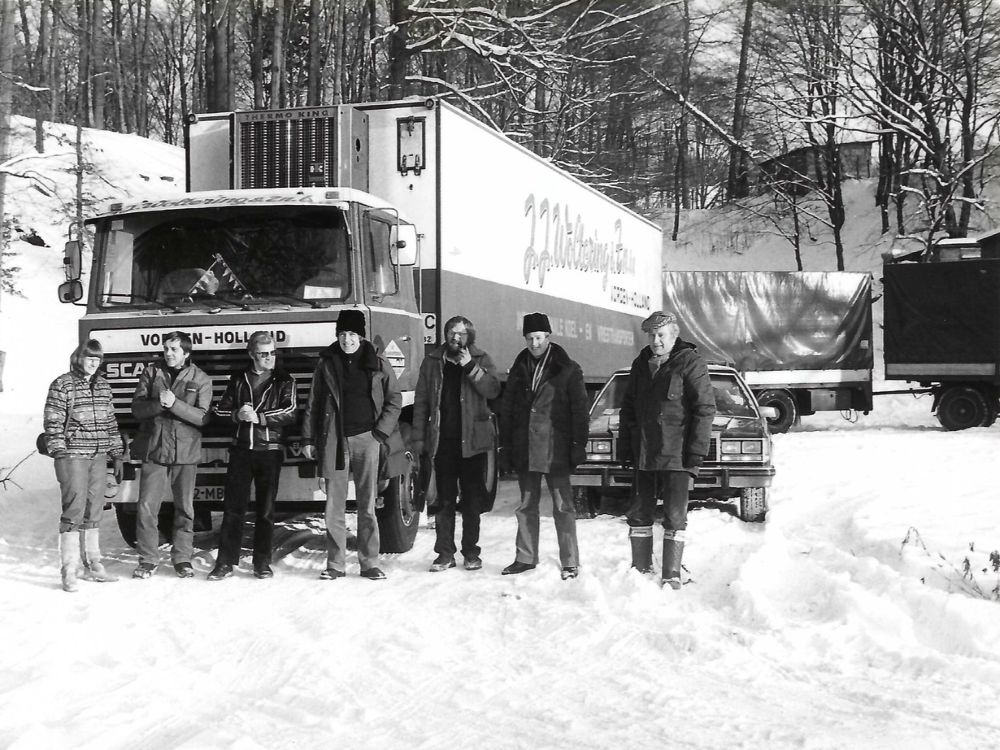
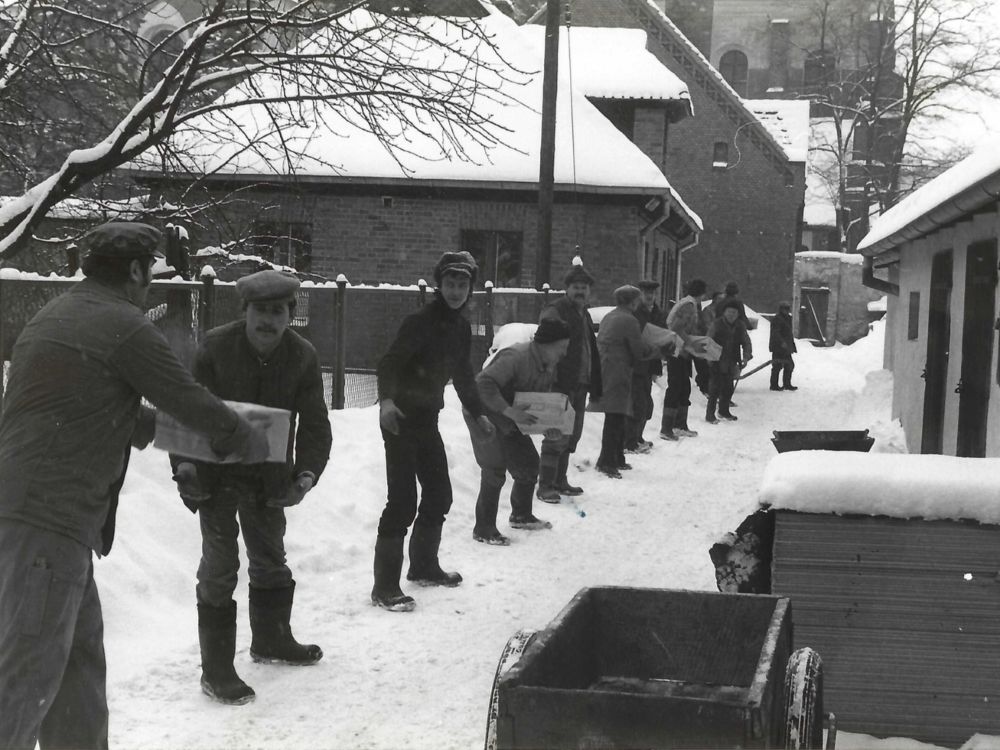
In the early 1980s, Poland was in the midst of a severe economic crisis. There were great shortages, and many basic necessities were rationed. Under the motto ‘Help the Poles through the winter’, aid campaigns were set up throughout the Netherlands. One of these was the ‘Pak van je hart’ (A Load off your Mind) solidarity campaign, in which lorry drivers collaborated with churches to provide the Polish population with food and clothing parcels. Aalten was not to be left behind and organised several aid shipments to the small town of Koronowo.
The Aalten team that travelled to Poland, photographed at the side of a road in the snowy landscape. From left to right: Mrs De Bruijne, T. Westerveld, H. Neerhof, J. Epema, D. Kuiperij; P. van Meggelen, and Rev. C. Gros. The photo was taken by Mr W. Hofs.
In December 1981, the following article appeared in a newspaper:
Tonny Westerveld, of Bevrijding 49, was one of the people who took part in the transport to Poland as a relief driver. The drivers of the first two lorries were Dick Kuiperij and Henk Neerhof. For Tonny Westerveld, who despite having ten years of experience as an international haulage driver, it was the first time he had driven to Poland.
On Saturday 18 December, the convoy departed at three o’clock in the morning, and seven hours later, they arrived at Helmstedt at the border between the Federal Republic of Germany and the GDR (East Germany). The formalities there took quite some time, as it was about two o’clock in the afternoon before they were able to leave.
Approximately three hours later, they reached the Polish border. Things went much faster there. The officials were required to open parcels, which they did with a few, but otherwise they finished very quickly—perhaps partly due to the many official documents with municipal stamps that could be shown, as Westerveld surmised.
The journey through Poland was hindered by heavy snowfall during the final few hundred kilometres. About 50 kilometres across the border in Łagów, they stayed overnight, but not at the location previously agreed upon; when they reported to the police, they were told they could spend the night at a different establishment.
On Sunday afternoon at around half past four, the convoy arrived in Bydgoszcz, where they were joined by a female guide, Mirca. The committee members had already been in contact with her a few weeks earlier, and she was well-informed about the situation.
In Koronowo
It was around eight o’clock on Sunday evening when they arrived in Koronowo. The priest they reported to was stunned when he saw the two large lorries; he could hardly believe his eyes, thinking that no one was allowed to enter the country.
The Aalteners requested help for the following morning. “You do wonder how long it will take to unload,” says Westerveld. Both vehicles were carrying 34 tonnes of cargo: 12 tonnes of clothing and 22 tonnes of foodstuffs. Of this, 28 to 29 tonnes were to be unloaded in Koronowo. The remainder was to be unloaded in Bydgoszcz. However, by the next morning, 12 Poles were ready to help, and by ten o’clock, that number had grown to about thirty.
Residents of Koronowo help unload the lorries. The goods were stored in a church building, and the priest would personally oversee the distribution.
“The people there were busy with something they didn’t quite understand,” as Westerveld put it. They were utterly amazed. By twelve o’clock, the goods destined for Koronowo had been unloaded, and the return journey via Bydgoszcz could begin. There, they met the minister of the Evangelical congregation, who looked at the Aalteners with no less astonishment than the priest from Koronowo. He had not yet expected any aid, and with increasingly bewildered looks, he watched the items being removed from the vehicles and piled up before his eyes. Finally, the medicines and syringes they had brought were delivered to the Warminsky Hospital in Bydgozcz.
The Return Journey
For the drivers, the question now was: how do we get out of the city as quickly as possible? But hospital staff were already waiting with a car to guide the Aalteners along the shortest route out of the city towards Poznań. They spent the night in their vehicles at a car park somewhere. It was very cold—about 23 to 24 degrees below zero.
On Tuesday morning, the journey continued after breakfast. They had brought various food supplies for the road. When visiting the homes of Polish residents, the meals they brought were heated up, but they could also fry an egg or make coffee themselves along the way if necessary.
About eighty kilometres from the border, they discovered an English motorist whose car had broken down. However, the Aalteners were unable to help him. To their great surprise, they saw a vehicle from the Dutch roadside assistance (ANWB) passing by. The situation was explained to the occupants, and the problem was subsequently resolved. The roadside assistance officers belonged to the large convoy that had returned to the Netherlands earlier, but they had been in Poland for about nine days because some had lost their passports and had travelled to Warsaw to make arrangements.
When asked: “What is the atmosphere like in Poland?” the answer was: “Fearful.” The people are unimaginably afraid. But it was immediately added: “They are also exceptionally hospitable.” On Wednesday 23 December at one o’clock in the afternoon, the two lorries and their occupants arrived safely back in Aalten.
Aalten is the only place in the Netherlands where a horn industry was established. Here, products were made from buffalo horn, such as pipes, combs, buttons, signal whistles, needle cases, and knife handles. Buffalo were not killed or specifically bred for their horns. Virtually all of the material was used, and the remnants were spread over the fields. With the advent of plastics and mass production after the Second World War, this industry disappeared.
Horn turners
Family ties had a strong influence on the emergence of the horn industry. From 1855, five horn turners began in Aalten: Bernard Vaags, Gerrit Peters, Abraham ten Dam, Willem te Gussinklo, and Wessel Becking.
Bernard Vaags went on his Wanderschaft (journeyman travels) to Germany, where he apprenticed with a horn turner in Ruhla (Thuringia). Upon returning to Aalten, he bought a simple foot-operated lathe and started the very first horn-turning workshop. In a small upper room of his parents’ shoemaking shop ‘in den Dijk aan de beek te Aalten’ (Dijkstraat 9), he made parts for German buffalo horn pipes. In 1860, Vaags married Dora Willemina Prins. She also became a horn turner and was known as Piepen Deurken. They moved to the house next to Bernard’s parents’ home (Dijkstraat 7).
Pipe turning was manual, pedal-operated, and skilled craftsmanship. Here is an example of an Aalten treadle lathe from 1880.
German pipes
Gerrit Peters, son of a tanner, also apprenticed in Thuringia after Bernard Vaags. From 1863, he worked on the Hogestraat. In 1866, Gerrit married the wealthy Josina Aleida te Gussinklo and moved into her home. The property covered the entire length of the Köstersbulte, from the living area on the Markt to the Landstraat, where he established his horn workshop. He produced long pipe stems and components for the German pipe. In Germany, porcelain pipe bowls were attached to the stems and the pipes were traded.
Combs
Comb factory Ten Dam & Manschot
After Vaags’ death in 1868, his successor, Abraham ten Dam, tackled the business thoroughly. The cottage industry became a proper factory at de Stegge. In 1871, he and his brother-in-law, Bernard Manschot, founded the comb factory Ten Dam & Manschot on the Damstraat.
It was the first and only factory in the Netherlands to make combs: white, black, and naturally coloured decorative combs, Mexican combs, nit combs, and moustache combs. These were made from buffalo horn, imported from countries including Brazil, India, and Thailand (then known as Siam). The manufacturing process generated even more dust and stench than pipe making.
A revolutionary development in the production process was the switch to steam power, replacing traditional hand and foot power. In local parlance, it became known as ‘d’n Kamstoom’ (the Comb Steam). By 1920, the comb factory employed about 200 people, including women and children.
Handles and knife hilts
German pipes, W. te Gussinklo
Willem te Gussinklo and Wessel Becking learned the tricks of the trade from Gerrit Peters. They worked together for a short time but separated in 1884. After the failed partnership, Wessel Becking continued in 1880 with Bernardus Gerhardus Vaags, a cousin and namesake of Bernard Vaags. Becking & Vaags made pipe stems and later also knife handles. When the sale of German pipes declined, the factory produced short briar pipes. The pipe factory in the Hoekstraat is still standing today!
Johannes Peters left his father’s workshop on the Köstersbult and, in 1896, formed a partnership with Marcus Gans, a Jewish merchant. Gans financed the firm called PEGA (Peters & Gans). The pipe factory stood next to Peters’ home on the then Gasthuisstraat (now Haartsestraat). In addition to German pipes for German reservists, walking sticks with horn handles were manufactured. After the factory burned down completely in 1917, Johannes Peters established his pipe factory on the Admiraal de Ruyterstraat. Instead of German pipes, they primarily produced briar pipes.
Buttons
Dutch Button Works, Bredevoort
After the failed partnership with Wessel Becking, Willem te Gussinklo made German pipes and handles for walking sticks and umbrellas. By 1900, companies in Germany and England had begun producing buttons from horn. With that example in mind, Willem started making horn buttons in 1905—a first for the Netherlands. Soon, his son Willem te Gussinklo Jr. (‘Piepkes Willem’) joined the firm, developing into an innovative entrepreneur.
Te Gussinklo’s first factory was at ‘t Dal in Aalten, the present-day Willemstraat. Due to the increasing demand for buttons, the company moved to the old Van Eijck weaving mill in Bredevoort in 1924. There, the production of buttons began. The international company N.V. Dutch Button Works (DBW) exported to England, Ireland, and America and was also the largest (horn) enterprise in Aalten.
After World War II, the production of horn buttons declined. In 1976, this last branch of horn processing was forced to close down. This marked the definitive end of 120 years of the horn industry in Aalten.
Video
Source: Euregionetwerk Industriecultuur
It rained pipe stems
Paulien Andriessen, a great-granddaughter of Gerrit Peters, became curious about her great-grandfather’s craft. He was the second horn turner in Aalten. Where had he learned the trade, and to whom did he sell those pipe stems? How did the Aalten horn turners and their successors fare?
“When I passed my final exams, my uncle gave me a pipe as a gift. My mother and my sisters smoked pipes, so I didn’t find it strange at all. It was a ladies’ pipe with a slender stem, a small white porcelain bowl, and a horn mouthpiece. I had to smoke it a few times, my uncle explained, and then a beautiful picture would appear on the pipe bowl. So, I started smoking quite heavily, as I was curious about that picture. It took a few pipes, but to my delight, my smoking habit was rewarded. A picture appeared. It was a little bird, a dove.”
In 2011, a book she authored was published by Fagus Publishers, titled ‘Het regende pijpenstelen, Honderd jaar hoornindustrie in Aalten’ (It Rained Pipe Stems: One Hundred Years of the Horn Industry in Aalten) (ISBN: 9789078202806)
In 1973, during restoration work at the Old St Helen’s Church in Aalten, carpenter Henk Heijnen stumbled upon a burial vault beneath the choir containing three coffins with human remains. At the order of the church board, the vault was swiftly resealed. However, before this happened, Heijnen had already climbed inside to meticulously measure and photograph everything. In 2019, Heijnen completed a wooden replica of the burial vault.
The Discovery in 1973
On October 16, 1973, the then 23-year-old carpenter Henk Heijnen was involved in restoration and maintenance work at the Old St Helen’s Church. The floor of the choir had been removed, leaving only sand. During the work, he was visited by Jan Tinnevelt from the Kattenberg, who asked if they were searching for the golden chalice. According to legend, this chalice was buried alongside the last priest of the Old St Helen’s Church. Heijnen’s boss at the time ushered Tinnevelt out.
However, Tinnevelt was persistent, returning at least three more times to ask if anything had been found. This prompted Heijnen to start digging at the spot under the choir that Tinnevelt had pointed out. He soon struck a brick vault. Together with his boss, he used a sledgehammer to create a hole in the structure. Heijnen enlarged the opening until he could descend into the space using a ladder. Below, he found a burial vault containing three partially decayed coffins. Of the deceased, only dust and hair remained. He did not find a golden chalice…
Measured and Resealed
As always, Heijnen had a folding rule, a carpenter’s pencil, and paper with him. Before the vault was closed again, he measured the space precisely, noted the dimensions and initials, and made sketches and photographs of the vault, the inscriptions, and the dates. On the wall of the vault were the initials IHW with the year 1746, GWA with the year 1815, and DR, without a date. He preserved all these notes and images.
Meanwhile, his employer had informed the church council. Around ten o’clock that evening, the members of the church board arrived at the church, accompanied by the Reverend Van der Heiden. The minister pointed out that no one should descend into the vault as it would constitute grave robbery. Because the restoration was being carried out without the involvement of the National Heritage Agency (Monumentenzorg) and there were fears that the work would be halted, Heijnen was sworn to strict secrecy. At the request of the church board, he had to seal the manhole with concrete as soon as possible.
While he was closing the opening, Jan Tinnevelt entered the church once more. Upon realising what had been found, he was again politely requested to leave.
Dagblad Tubantia, 2 March 1974
In the week following the discovery, work began on laying the new natural stone floor in the choir, permanently sealing the access to the burial vault. Only Heijnen’s notes and his employer’s photographs remained as a source. Shortly after the completion of the choir, national news channels reported the discovery of a burial vault in the Old St Helen’s Church; it is not known who leaked this information.
Research and Replica
The portraits of Lambert Joost van Hambroick and his wife Mechteld Anna Bentinck-Van Diepenheim, photo: Lydia ter Welle
It was only years later, during a trip to Israel with his wife, that Henk Heijnen visited a burial vault in Jerusalem. This gave him the idea to build a replica of the burial vault in the Old St Helen’s Church.
He produced new construction drawings and came into contact with Herbert Welling from Bocholt and Thaddeus van Eijck from Bredevoort, both of whom were interested in cultural heritage. The trio hit it off, and their combined research led them to the historian J. Grooteboer from Borne.
They discovered that Lambert Joost von Hambroick and his wife Mechteld Anna Bentinck van Diepenheim were closely connected to St Helen’s Church. In 1706, they donated two silver communion cups to the Aalten church, which were later found in a safe within the church.
Replica of the burial vault in St Helen’s Church in Aalten, photo: Aalten Vooruit, 4 October 2024
Who Was Buried in the Vault?
Based on the research, it was determined that the following individuals were buried in the vault:
Judith Hambroick Welvelde († 1746) The connection to the Welvelde and Hambroick families is still visible in the church via the Welvelde coat of arms, which features a wolf’s head.
Gerharda Wilhelmina Arentsen (1777–1815) She had purchased the burial vault at a later date. She was the daughter of the sister of Mayor Christiaan Caspar Stumph and the granddaughter of Roelof Arentsen, the scholte (local official) of De Ahof.
Rev. De Roy († 1762/1785) Uncertainty remains regarding the initials DR. They were linked to a Reverend De Roy. However, in the second half of the 18th century, there were two ministers of that name: Philippus de Roy (1733–1762) and his son Adrianus Rudolphus de Roy (1762–1785). Which of the two might be buried in the vault remains unknown for now.
Completion of the Replica
In 2019, Heijnen completed a wooden replica of the burial vault. Two employees from Broekhout used his drawings to recreate the frame exactly. Heijnen personally handled the painting, including the initials and other details. The replica was later put on public display in the Helenahuis, opposite the church on Landstraat.
Thaddeus van Eijck produced a film titled “Verscholen erfgoed in beeld” (Hidden Heritage Portrayed), which documents the entire process surrounding the replica: from the initial notes and research to the craftsmanship with which the burial vault was reconstructed.
At the presentation of the replica in 2019, Heijnen mentioned that he still always carried his folding rule, even when sitting in church on Sundays, and that he felt nervous if he did not have it on him. That habit led to an extraordinary result: a booklet, a film, the recovery of two silver communion cups, and a skilfully and accurately crafted replica of the burial vault in the Old St Helen’s Church. Hidden heritage, beautifully brought to light.
A report on the presentation of the replica of the Old St Helen’s Church burial vault on the Market Square in Aalten. Video: RTV Slingeland / Henk Nijenhuis
The textile industry in Aalten was deeply rooted in the centuries-old tradition of domestic weaving and flax processing. In the 19th century, this craft grew into a flourishing industry, partly thanks to the establishment of German textile families such as the Driessens.
For centuries, flax was cultivated in the Achterhoek and the adjacent Westphalia region, from which linen was woven on farms. This cottage industry led to a lively cross-border trade in woven fabrics.
Numerous farm and street names in Aalten still recall this era, for example: de Weversborg, de Pellewever, de Bleeke, the Vlasspreideweg, and—due to the pure water—the Zilverbekendijk.
The arrival of the Driessens
Import duties on foreign fabrics were increased in 1823 to protect Dutch industry. German textile companies, including the firms Gebrüder Driessen and Peter Driessen & Sohn in Bocholt, moved to the Achterhoek. In 1826, they established themselves in Aalten.
With their arrival in 1826, 56 looms and approximately twenty families from Prussia also came to Aalten. Most of them settled here permanently.
Growth of employment
The number of domestic weavers grew steadily. While the number was 292 in 1828, it had risen to 352 a year later, and in 1833 it was reported: ‘The fustian factories continued strongly, with the factories in Aalten typically employing approximately 630 weavers according to records. Both in this and in the surrounding municipalities of Winterswijk, Dinxperlo, Varsseveld, Lichtenvoorde, etc.’
Spinning flax on the spinning wheel
The first factories
In 1829, there were two cotton mills in Aalten ‘which provide work for about 40 people’, including that of the Driessen brothers. In 1830, there were three, with approximately sixty employees.
On August 15, 1829, Jan Gerard Kraak ten Houten, ‘licensed shopkeeper and merchant in Aalten’, informed the Governor of Gelderland of his wish to establish ‘a fustian factory, spinning mill, dye works, and bleachery’ in his hometown, for which he requested permission. The municipal council had no objections to this establishment, ‘considering that the petitioner’s intention is only to have fustian manufactured by weavers at their homes, without erecting a spinning mill, bleachery, or dye works. This ensures sufficient work for the craftsman’, while no other interests are harmed. Ultimately, the King had to decide on the matter. Favorable advice was given by all advisors. It is not known how long this company existed or where it was located.
Sources
Geweven goed, the textile history of Aalten and Bredevoort H. de Beukelaer, J.G. ter Horst – Fagus, 1992
GROENLO — The Groenlo cantonal judge, Mr H. J. Steenbergen, was confronted yesterday afternoon with a modern-day Robin Hood. The youthful J. P. from Bredevoort had turned back the clock centuries and had gone hunting in Aalten armed with a bow and arrow. But since the days of Robin Hood have long since passed and legislation today is entirely different, he came into conflict with the hunting laws.
With this primitive weaponry, P. had terrorised a plot of woodland between the Walvoortweg, the Stationsstraat, and the Bredevoortsestraat. The forest is named Het Zwarte Woud (The Black Forest) — a name that fitted wonderfully with the adventurous atmosphere in which historians have shrouded the gallant followers of King Richard the Lionheart.
The Bredevoort archer had set his sights on creatures walking through life on two or four legs and on anything winged soaring through the air, but he went from hunter to hunted when the police caught him in their sights. It then appeared that P. was no true follower of the great hero from the exciting story. He dropped the bow and made off. However, he lacked the cunning and the speed of Robin Hood, who was always too slippery for his pursuers, and so P. — after handing his arrows to a friend — fell into the trap. His adventure was over.
P. looked at the cantonal judge sheepishly when the latter made him understand that he had made himself guilty of illegal hunting. That his game would have such far-reaching consequences and also financial repercussions took him by surprise. Somewhat crestfallen, he managed to blurt out that it was not hunting he was after, but purely the sport. The sensation that shooting with a bow and arrow provided him pushed the rules and regulations far into the background. “You did shoot at animals with it, though,” asked Mr Steenbergen. “Tried to, but I wasn’t very successful,” P. answered. He had bought the bow in Germany.
The cantonal judge had put the weapon to the test and had come to the conclusion that it was a dangerous piece of equipment. “The heavy arrows, tipped with a metal point, whizzed hard through the air,” he said. Mr Steenbergen also inquired why P. had run away. “Didn’t you feel very well?” he asked. “I don’t know,” P. stammered.
The public prosecutor, Mr J. Punt, was of the opinion that someone roaming the fields with such hunting gear is clearly hunting. He felt this deserved no encouragement, and in order to deter other Wilhelm Tell figures, he demanded a fine of 60 guilders or 6 days’ detention, and the forfeiture of the bow and arrows. The cantonal judge declared that P. would have acted more wisely by joining an archery association, and if such an opportunity had existed in Aalten, he would have been inclined to let P. keep the bow and arrow. However, that possibility does not exist, and therefore Mr Steenbergen deemed it necessary to confiscate the weapon. He sentenced P. to a fine of 30 guilders or 3 days.
Deze website gebruikt cookies voor een optimale ervaring en analyse van bezoekgegevens. Ga je hiermee akkoord? Zonder toestemming werken sommige onderdelen van de site mogelijk minder goed.
Functioneel
Always active
De technische opslag of toegang is strikt noodzakelijk voor het legitieme doel het gebruik mogelijk te maken van een specifieke dienst waarom de abonnee of gebruiker uitdrukkelijk heeft gevraagd, of met als enig doel de uitvoering van de transmissie van een communicatie over een elektronisch communicatienetwerk.
Voorkeuren
De technische opslag of toegang is noodzakelijk voor het legitieme doel voorkeuren op te slaan die niet door de abonnee of gebruiker zijn aangevraagd.
Statistieken
De technische opslag of toegang die uitsluitend voor statistische doeleinden wordt gebruikt.De technische opslag of toegang die uitsluitend wordt gebruikt voor anonieme statistische doeleinden. Zonder dagvaarding, vrijwillige naleving door je Internet Service Provider, of aanvullende gegevens van een derde partij, kan informatie die alleen voor dit doel wordt opgeslagen of opgehaald gewoonlijk niet worden gebruikt om je te identificeren.
Marketing
De technische opslag of toegang is nodig om gebruikersprofielen op te stellen voor het verzenden van reclame, of om de gebruiker op een site of over verschillende sites te volgen voor soortgelijke marketingdoeleinden.